Sunday, 26 July 2015

5 Fantastic Web Based Apps that Make Social Media Marketing Easier

Social media marketing got you in a tizzy? Don’t fret …because you are not alone.
Thanks to changes in the technology landscape, the introduction of various web based applications has most definitely made things a tad bit easier for us all.
I’ve previously written a few posts closely related to this topic: one that covers social automation tools and the other covering resources that can be used to grow your social media following – putting things on cruise control.
Today, I’ve decided to revisit this topic (because I heart social media) and also—because I am a true “tech” tools user.
Any resource or tool that makes online marketing a little easier, I’ll put it them to good use.

Web Based Apps for Social Media Marketing

1. Shareaholic Browser Extension

This extension let’s you quickly and easily bookmark and share content that you love right from the web to your social media networks. Awesome right??
Shareaholic Web Extension
Shareaholic has easily become one of my favorite web applications that I use to share information with my fans via social media while I am on the go.


Oh and I forgot to mention, if you have a WordPress website, then you should also check out their plugin to add to all of your pages, and posts to encourage visitors to share your content.

2. SumALL

SumALL is a Social Media Engagement and Analytics Tracking tool that I use. I have to give kudos to one of my Twitter followers “The Credit Woman” for introducing me to this resource. Guys it is a phenomenal tool!

SumAll Dashboard


Here’s what you can do with it:
  • For Twitter (it will automatically send out Thank You Retweets and recognition to your most engaged fans and members of your community that send out your “Best Retweets
  • For Facebook (the tool features a “Throw Back Thursday” post to your page and shares an old post that performed well with your Facebook community.
  • Metrics and Data reports (every day I receive an automated email that gives me the skinny on how well my social media posts have done on all of my active networks). This helps me gather important data about my social networking and marketing activities to see what’s working and what’s not.

3. Evernote Web Clipper App

This web based app helps you easily put together and “clip” a list of content that you can share on your social media networks.
Evernote Web Clipper


Content curation is the thing these days. If you want to save time and quickly put together a list of “noteworthy” content to share with your community, then Evernote’s clipper app is the way to go.
Additionally for you super techies and heavy smartphone users, the Evernote mobile application works just as well.
Here’s a secretthis is a resource that I use for my Monthly Small Business Roundup blog posts.

4. Bit.ly (The URL Shortener)

Bitly is an additional favorite web based application and extension that I use for sharing content.

Bitly_Screenshot 

What it does is essentially takes your original link to content and creates a “shorter” version of it. In addition to this, you can use the Bit.ly extension to see how well the links that you share on your social networks are performing.
Bit.ly is especially helpful for Twitter users since you can only tweet out content with up to 140 characters.

5. ShareThis (Chrome and FireFox)

This is a web based extension (like Shareaholic) that lets you share content anywhere and anytime from your Google Chrome or Mozilla Firefox.
ShareThis Screenshot


Again, this is a huge time saver for social marketers that find great content via the web and want to share it immediately via your social networks.
Well there you have it, 5 awesome web based apps that make social media marketing easier.
Source

Saturday, 25 July 2015

Three Things Social Media Will NOT Do For Your Business

All of the blog posts I write are dedicated to the power of what social media CAN do for your business. And if you’ve been reading this blog for more than a couple posts, you know I love social media and the impact it can have on a business. But, despite all that, there are three things that social media will NOT do for your business.
Whether it’s talking to a business owner or reading a post somewhere, inevitably, some people think that social media will be their instant cure-all to fix all their problems. Of course, the endless posts titled “How I tripled my business in two months” or “How I gained 10,000 followers in 8 simple tricks” or other similar, misleading titles don’t help with the realities that we actually face on social media.
Yes, these businesses and bloggers often did see the “success” they claim in the titles. But their tactics may be questionable. The results may actually have no financial or actual value to their company. And most of the time, the “methods” they used are vaguely outlined with little detail on the what actually went into the process.
And yet, they leave these struggling business owners with the idea that they too can go “viral” or find the hidden gold-mine of customers just waiting to buy up all their inventory.
And so, I want to dispel the three myths that many think about social media marketing.

Social Media Will Not Turn You Into An Overnight Success

I’m sorry to be the one to tell you this. But you do not launch a Facebook page on Monday and see rapid growth, sales, and overnight popularity by Friday. The Today Show will not be calling you to participate in a segment on their show. You will not get book deals. Heck, you won’t even get a few hundred followers on Facebook in a week. Well, not “real” or targeted ones, at least.
Just because you’re on Twitter doesn’t mean the thousands or millions of potential customers out there are all of a sudden going to find you and immediately sing your praises.
Social media takes time. A lot of it. It takes time for you to commit to it every day. It takes time to grow and cultivate an audience around your brand. It takes time to build engagement and interactions. It takes time to figure out what your audience really wants to see on social media – and, no, it’s not endless inspirational posts.
And for those few, rare people or companies that see a video or article go “viral”, most of those are a combination of well developed content conveniently posted at the right time with the right people interested in that message. Or, you could call it luck. You don’t really “plan” for viral content. In fact, most people that have had content go viral have stated that it was the one piece they didn’t plan out like everything else they normally do.
And even then, do you know what typically goes “viral”? It’s entertainment. It’s a video of cat playing with a monkey. It’s a video of a little boy busting out the most adorable break-dancing moves at a wedding. It’s a photo of some politician making an awkward facial expression turned into a meme. Let me ask you honestly – what do any of these things have to do with your business or product? Probably not much.
So, expecting that you’ll just jump on this whole social media thing, and all of a sudden your content will spread like wildfire is a more than a little delusional.
Instead of planning on overnight success, I recommend you stop and think about what you actually want from social media. Then plan. And plan on spending real time on social media. And set realistic expectations for “success”.
I don’t mean to be the cranky-pants, run-in-the-other-direction pessimist. I love social media and think it can do a LOT for your business. I even believe you can do a lot in short amounts of time. But those expectations need to managed realistically and planned for in order to really see those results.

Social Media Will Not Guarantee Sales

Similar to not being an overnight success, social media won’t just start generating endless sales for your company. Sure, it can generate sales and sales leads for you. But this is not going to be the primary result and it certainly won’t be the sales funnel to make you a millionaire by the end of the month.
I have to point out here that social media has a key root word: “social”. That means it’s about creating a community, an environment, a conversation, and a relationship with your audience.
You cannot go onto a social media platform, open an account, and start posting “Sale!” or “Available Now!” or “Buy” or “Get it Now” or any other in-your-face sales pitch post after post. You will alienate more of your audience than you will gain using this tactic.
Instead, you’re going to need to take time sharing content of value. Share your story. Engage with your audience. Get a little bit more personal or “human”. Actually talk to your audience. Post the things they want to see/read. And then, amid all this valuable content that your audience actually connects with, you can throw in the occasional sales post to encourage them to buy something.
But understand that this may not even drive the sales.
Most people are not on social media to buy. They’re there to socialize, interact with friends and family. They’re on the go. They’re relaxing on the couch. They’re commuting to work. They’re on a lunch break. They’re distracted. So your pitch to “buy something” probably isn’t the best time.
That doesn’t mean you can’t drive sales. Your post may trigger a thought and they’ll visit your site later when they have time. Or you might find a way to collect their email address from a social media post where you can later market to them via email – when they’re more likely to buy. There are numerous ways you can grow your business and generate sales from social media. But understand that just posting to social media for the sole purpose of selling isn’t going to drive all these new sales your way.

Social Media Will Not Fix Your Bad Reputation or Product

If your reputation sucks, well that’s on you. If your product (or service) sucks, yeah, that’s on you too. And you know what’s going to fix that? Not social media!
In fact, social media will inevitably make this worse! This gives people a public platform to discuss and share the ways in which you suck.
So, if your brand reputation or your product sucks, stop and fix it! Fix the product. Take care of your customers. Offer solutions. Change the perspective people have of your company. Oh, yes, this will take a boat-load of time and probably money for you to do.
To be fair, I think social media is one of the best customer service platforms available to companies and I think it can do a lot to help businesses overcome negative feedback. But it requires a quality response plan, responsible and respectable people to respond to and resolve those issues, and a consistent message of putting your customer first. And, let’s face it, if your brand reputation is really bad, you’re probably not in a position to do these things. So if you’re not willing to invest in improving your company reputation the right way, why would social media be the answer?
It won’t be. It will be the magnifying glass that highlights your shortcomings.
Well, now that I sound like the biggest negative-Nancy out there, I hope I haven’t chased you away from social media. As I mentioned, I love social media – that’s why I’ve been blogging about it for two and half years. And I am a personal testament to the power of using social media to grow a business. But I also like to be realistic and transparent with you and I don’t want you to enter into social media marketing with delusions of grandeur or unrealistic expectations that will leave you frustrated or, worse, have you give up.
If you want to talk more about how social media CAN work for you or what you can do to see success with social media, let me know and we can get you on a clear path in the right direction!

Friday, 24 July 2015

20 Ways To Amplify Your Social Media Reach

Social media is one of the most powerful tools I have come across to grow a large audience and spread your message. In less than three years, I went from no audience to hundreds of thousands of followers on Twitter alone.
Social media is an opportunity that people can no longer afford to take for granted. Social media is not a fad. It has redefined how we share information, interact, and grow our audiences. Amplifying our reach on social media has become more important than ever. In order to amplify your reach on social media, follow these 20 tips:
#1: Grow A Targeted Audience
A targeted audience consists of a group of people who are interested in the niche that you tweet about the most. My targeted audience consists of people who are interested in digital marketing advice. You can grow a targeted audience by finding influential people in your niche and following those people’s followers. When you do this, be sure to follow the people whose ratios indicate they are likely to follow you back.
#2: Follow People
It does not hurt to follow people, temporarily sacrifice your 1-to-1 ratio, or eventually follow hundreds of thousands of people. When you follow someone, you are sending an invitation for that person to connect with you. I know that sounds a lot like LinkedIn, but both Twitter and LinkedIn are social networks which means they have similarities. Following someone else, and then that person following you builds a connection between you and that other person. Imagine having hundreds of thousands of these types of connections. I would rather have 100,000 followers and follow 100,000 people than only have 1,000 followers and only follow one person. You can take this approach on nearly any social network, and I saw great success when applying this process to my Pinterest account.
#3: Post More Often
The entire concept of posting too often being bad is a myth mixed up with what some would call fury posting. Fury posting is when someone sends dozens of posts in about five minutes. Although this type of posting is annoying and ineffective, scheduling numerous posts throughout the day is not as annoying, and it can be very effective. I schedule one tweet every 15 minutes, and although I know that annoys a small handful of people (you can’t please them all), many of my followers like the added value of my tweeting once every 15 minutes.
#4: Post More Pictures
Including a picture in your posts is one of the easiest ways to boost engagement. Posts with pictures have been proven to get more engagement than posts without pictures…on every social network on the web. You can find a picture on Google or create one with Canva to match what you want to talk about. As long as you provide a picture that complements the post’s typed content, that post will be sure to get more engagement.
#5: Post Better, Stunning Pictures
We don’t want blurry pictures. We only want the cream of the crop. Since millions of pictures are posted every day across all of the major social networks, social media has a fair share of good and bad pictures. Therefore, a decent picture will no longer make the cut anymore. You must focus on including stunning pictures in your post. Take the time to look for the best picture available, and if you decide to create your own picture, make sure you take the time to see if any improvements can be made. Don’t just go for the first picture you see in Google’s search engine or the first picture idea you think of when you are on Canva.
#6: Post Valuable Content
Many visitors who visit a social media account for the first time never visit it again. In order to prevent that from being you, it is essential for you to constantly post valuable content on your social networks. The value of your content determines how many people revisit your social media accounts, and how far your content spreads.
When you share content on your social networks, be sure to only share valuable content. If you read an article that you thought was fascinating or valuable, feel free to share it with your followers. Those are the types of articles that encourage followers to stick around, revisit your social media accounts, and share your posts.
#7: Use Multiple Social Networks
Billions of people use social media, but not everyone uses the same social networks. Some people only use Facebook while other people use Twitter and Pinterest, but not Facebook. The combinations vary based on the individual, and few people spend an equal amount of time on all of their social networks.
Being active on multiple social networks will allow you to reach to a larger active audience. Many people who are active on one social network are inactive on other social networks. Being on all of the major social networks will allow you always interact with an active audience.
#8: Focus Most Of Your Time On One Social Network
Although it is important to use multiple social networks, most of your time needs to be focused on one social network. For me, that would be Twitter. It is so important to focus on one social network because of the learning curve. It is difficult to learn how to master 10 social networks at the same time. However, it is easier to learn how to master one social network at a time.
I like to compare social media mastery to mastering the romance languages. The romance languages have the same general structure, just like social networks. If you know how to be successful on Twitter, then you almost have all of the knowledge needed to be successful on Pinterest or a social network similar to Twitter.
As you become more successful on more social networks, it will be easier to become successful on other social networks. Let the sentence sink in, and read it again. It is better to take social media success one step at a time than trying to take 10 steps at once.
#9: Share Other People’s Content
Did you know that it is statistically proven that people unfollow the ego maniacs? If you are constantly talking about yourself, promoting your own articles, and promoting your own products, then you need to take the time to share what other people have done. Your timeline does not have to be taken over by articles from other people’s blogs, but if you share someone else’s blog post here and there, your followers would greatly appreciate it, especially if the blog posts you share are valuable.
#10: Interact With Your Audience
Interacting with your audience is important towards growing that audience and building quality relationships. Regardless of your audience’s size, there will be people in that audience who will be grateful that you took the time to respond to one of their posts. One conversation has the potential to start a strong relationship.
Getting a conversation started is as easy as thanking someone for sharing one of your posts, saying hi, or jumping into a conversation (without coming out as brash).
#11: Add The Personal Touch
The personal touch is one of the most underrated ways to increase your reach on social media. As more people get impacted by your message and enjoy the value you provide, some of them will want to know what you do when you are not on social media. You don’t have to give every second of every detail of your life, but you can let people know things about you that are important.
If you watch baseball games every night, your followers may occasionally want to know that. If baseball is not your niche, you wouldn’t send daily posts about you watching baseball. For these types of activities, you should only talk about them 1-2 times per month. You can talk more freely about events in your life that you believe are important enough to get the spotlight on your social networks (in other words, don’t tell us what you ate for breakfast. Tired of seeing that breakfast example on so many blogs?).
The personal touch will allow people to know more about who you are. It is okay to branch out of your business to add the personal touch because your followers will feel more connected to you than ever.
#12: Do Research
Most of the knowledge I obtained about digital marketing came from hundreds of hours of research. I would look up popular, valuable, niche-related blogs and read through all of the articles on those blogs. To this day, I continue to read a variety of articles from fellow bloggers in my niche to learn more about expanding my social media reach. I also recommend subscribing to their blogs so you get notified every time they come out with new blog posts. That way, you will be able to stay up to date with the latest trends in your niche.
#13: Read Social Media Books
I wish I could say I read many social media books, but that is not the case quite yet. I have been making progress though. I started reading What The Plus!: Google+ For The Rest Of Us by Guy Kawasaki. I have read various books in the time management field even when I knew (thought I knew) how to effectively manage my time. I was productive, but reading a few bestsellers about productivity dramatically increased my ability to get more done faster. You can never know too much about social media, and as you gain more knowledge about social media and different social networks, you will have a better idea of what you need to do to grow your reach.
#14: Automate Your Content
When I send out one tweet every 15 minutes, you better believe I’m not up at 4 am eastern time sending out those tweets. However, while I am sleeping, other people are having their morning coffee, attending school, enjoying the afternoon, or having an evening dinner. All of those things happen in different places in the world while you sleep.
Therefore, people are reading my tweet at 4 am eastern because it’s a different time of day in Germany, England, Russia, China, Japan, and any other timezone out of the east coast. You don’t need to master geography to be successful on social media, but if you strive to grow an international audience, you need to be aware of the fact that our world is filled with many timezones.
#15: Tweet At The Moment
Automating your content allows you to consistently provide content to your followers over a long period of time without you being on a computer, mobile device, or tablet. In some cases, tweeting at the moment will prove to be an effective tactic towards growing your social reach, especially if you take advantage of current events.
Few businesses were prepared for the blackout in the Mercedes-Benz Superdome during Super Bowl 47. Oreo was prepared, and it was on this day that Oreo sent its famous tweet about still dunking in the dark. This tweet made marketers all over the world pay more attention to tweeting at the moment, and it is a tweet that has been discussed and analyzed in thousands of presentations all over the world. I have analyzed this one tweet in multiple blog posts and videos. It’s amazing what 140 characters can do.
#16: Turn Social Media Conversations Into Email Conversations
Social media conversations only last for a long period of time, and some conversations are forgotten about due to the countless distractions that social media throws at us. If you can turn some of your social media conversations into email conversations, then you will remove all of the distractions and character lengths that prevent a conversation from growing in size. Sure, there are distractions in the inbox, just like any social network. However, we have been hardwired to make sure we look at every email (for some of us, even the spammy emails) in our inbox. If we don’t look at every email in our inbox, then we’ll definitely click the “Mark All As Read” button.
Email conversations are the best conversations to have with your followers because email conversations tend to be the most sincere, and they typically last for a longer period of time than social media conversations.
#17: Promote Your Landing Pages On Social Media
Having a big email list allows you to connect all of the promotion of your social networks in one place. On this email list, you can promote your latest Pinterest boards, YouTube videos, Instagram photos, your Twitter account, and more. Landing pages are critical components towards growing your email list, and what better place to promote your landing page to the audiences you have already built on your social networks?
#18: Have A Good Avatar
The picture you choose for your avatar has a big impact on how many people follow you after taking a look at your account. If you are using a personal account, have a picture of you. That means no egg, cartoon character, or anything else. The best picture to have for your personal account’s avatar is a picture of you. If you manage or own a business account, the ideal avatar for getting more followers would be a picture of the business’ logo.
#19: Improve Your Bio On Your Social Networks
It is always worth checking your bio every once in a while because it could be outdated, or it may not highlight one of your most recent accomplishments. You should improve your bio to highlight your credentials and the hobbies that you do outside of your business.
When you don’t have many characters to play with, use commas to list credentials and hobbies one by one. Sentence fragments and not including a period at the end of the sentence are okay. If you have more characters available, use periods at the end of sentences (if you want to write in complete sentences, the social network you are using must allow you to use at least 300 characters). Make sure all of your bios on your social networks are similar or identical. When people transition from one social network to the next, they’ll recognize you by your avatar and bio description.
#20: Have A Stunning Background/Header Picture
Some social networks call it a background picture while others call it a header picture. Regardless of what it is called on the social network you use, the picture behind your avatar needs to reflect what you do and promote one of your products.
On my Twitter header, I promote my free eBook 27 Ways To Get More Retweets On Twitter and make my message stand out (Age Is Not A Limit To Success). Your background/header picture can’t just be a random picture from Google. It needs to be a picture that lets people know more about you or your business.
In Conclusion
Amplifying your social media reach is not as challenging as it seems, especially if you have the right knowledge in place. One of the most important tips I could ever give it to be patient on social media. There were times when I wanted to give up on Twitter because I was practically frozen at 1,667 followers for 1-3 months. I’m happy I stuck with it. If you stick with social media and learn new techniques (by reading books and conducting your own research) you will grow your social media reach and spread your message farther on the web.
Which of these tips was your favorite? Do you have any other tips for amplifying social media reach? Please share your thoughts and advice below.
Source

Thursday, 23 July 2015

What Brands Can Learn from Customer Conversations on Social Media

Consumer conversations surprise brands in a lot of ways. Customers often care more about some things than a brand realizes and less about what the brand thinks is important. This can affect social media, marketing and even product decisions.
In recent years, General Mills learned through customer conversations that families were playing with the Pillsbury dough, making shapes and designs for fun; not just cooking with it. Based on this insight, General Mills revitalized a tired brand by focusing on the family activity value the product enables.
Learning more about your customers from social and impacting your business is not new. Several years ago, Sun Microsystems discovered software developers were not talking about the category of tools they, IBM, and Microsoft were developing. Rather they were talking about a set of tools nobody was advancing. With this insight, Sun changed its strategy, re-allocated its budgets to the tools developers were interested in, and leaped ahead of their competition.
Customer conversations can also reveal that the message the brand intends to transmit via its marketing is not the message being heard. Either the marketing needs to be improved, the target audience changed, or a fundamental product change is needed. Conversations can also reveal customer support issues. In some cases, customers will solve each other’s problems through those conversations.
Social data from conversations outside your brand — say product category or target audience level — reveal insights about what consumers care about and why. This can inform your product development, business strategy, messaging and positioning, and inform the tactics you pursue to win customers.
Social data from customer conversations can provide brand, product, and consumer insights that you can apply to everyday marketing decisions. Social provides a rich, real-time, rejuvenated data source that brands are using to make smarter decisions.
Then there is the business benefit of higher customer satisfaction with lower costs by managing customer support issues in social media. Your customers are already there, trying to talk to you and trying to find resolution. Increasingly, the category leaders will be the companies who create positive customer experiences on both the pre and post sales side.
Phone support costs anywhere from $10 per inquiry (offshore and fully costed) to $23 per inquiry (US average for typical consumer products) to over $100 per inquiry (Cable TV), with Email and chat typically running $5-$10/inquiry. Customer support via social media discussions (a discussion thread on Facebook or a community web site discussion board) can be as little as $2/inquiry if a support agent is involved, or $0 marginal cost when the customers answer each other’s questions, which they like to do.
Social media empowers your customers to help each other, which is a rewarding experience for them and builds a knowledge base for the brand. Generally, your customers as a whole know more about the products than the brand does. In social, we say, “Nobody is as clever as everybody.”

Wednesday, 22 July 2015

Cost-effective alternatives for advertising on social media

Marketing on social media can seem like a wallet buster for your average startup, but absolutely necessary for the company to grow.
With changing advertising rates and rules on social media sites such as Facebook, there are limited options for startups to advertise on these sites in a budget-friendly way.
The startup needs to grow an army of loyalists who believe in what is being offered, and then the loyalists need to be willing to share their likes, dislikes, and overall thoughts with others.
Here are some cost effective models of advertising that won't break the bank.

Social media platform advertising programs

Let’s start with the advertising options that the major social media platforms have developed to generate revenue from their business models.
Facebook has led the pack for social media advertising, but has fallen out of favour with many businesses who cannot afford the rising advertising rates and restrictions. Facebook is also falling out of favour with some of it's own crowd because of said advertising.
Some innovative businesses have found unique ways to still be able to use Facebook without paying significant rates. This tactic includes the planning of events for a business by using the event invitation feature.
Using this event invitation feature gets attention among followers who want to attend the event, and these devoted fans will often share details of the event with friends. As a result of this sharing, the attention is garnered by others on the site who will hopefully see the information and join the event themselves.
The only cost involved is to actually host the live event, which can be online or in person, but this creates a way to offer incentives and rewards through the event without paying for the actual advertising. Even if people cannot make it to the event, they have still seen your company and may look up information about it anyway, out of curiosity.
Pay attention to the social media platforms where the greatest engagement is now occurring with your potential target audience. Forrester Research has concluded thatInstagram is one of the best advertising platforms for getting the maximum organic, granular reach for your advertising dollars.
If you have any type of marketing budget as a startup, focus it on the sources where you are likely to get the most attention, including a group of followers who will easily share their adoration with others in a convincing, credible way.
Research will tell you where your audience spends most of their time on social media, whether that is Instagram, LinkedIn, or Facebook, make room and a budget to create small campaigns and test their effectiveness on these traditional channels.

Other advertising avenues

Partnering with others who have their own blogs or who write for review websites is a relatively low-cost social media strategy to employ.
The freelancers behind these popular blogs and online reviews are eager to report on new products and services so they are willing to work for an affordable rate, or simply for a free product that they can use for their article and then keep for their own use.
The benefit to this partnership is that you can get the word about your startup on established blogs that have a significant following who, in turn, may share that blog post about your company with their networks.
This is word-of-mouth-marketing (WOMM) in action and is designed to generate greater results than traditional targeted ads on profile pages. Many startups and small business have completely ignored this phenomena in the past, but can little afford to disregard its benefits now.
Using incentives like sweepstakes or giveaways can be used to reward your customers who talk about your product or services. Plus, you can post your sweepstakes on all your social media sites with a link.
Companies like Rafflecopter provide a way to create an incentive and a giveaway code for something that your audience sees as having real value.
Another low-cost idea to your lower budget/higher yield advertising plan is to apply for business awards. If you are chosen for one of these business awards, you can then market this news on your social media sites, and you can be sure the award organizations’ sites will be spreading this news as well.
These awards include competitions like Entrepreneur of the Year, Red Herring’s Top 100 in North America, and watch for local competitions within your region that are tied to a business publication.
These are either free advertising or may have a minimal fee attached, but this attention will deliver big returns in the promotional value of being recognized by a large organization for your innovation and growth potential.

New social media advertising models

New companies are emerging with unique advertising models that provide a way to mobilize existing followers and a site, and have these followers take the lead on promoting your startup.
For example, Influence Network does this for companies that have multiple locations and want to identify and engage their most loyal followers in each unique location.
Once this mobilization happens, you can reach out to these advocates and share personalized information and content that is meaningful for them, and the information is delivered in a format that allows the site user to easily pass on their interests to others on your behalf.
Essentially, companies like Influence Network are taking the advantages of WOMM to the next level with technology, while using existing social media platforms to advertise your business.
It recognizes and proves that there is influence among your existing followers that can be mined to generate highly valuable publicity.
This is the power of social media truly unleashed, in a way that is affordable and delivers great return on the investment.

Final Thought

While social media platforms are trying to monetize what they do, and you are attempting to gain the most advertising bang for your buck through these platforms, there is a middle ground where you can use the ideas provided here to maximize the effect of social media advertising with the least amount of expenditure to you and your company.

Tuesday, 21 July 2015

8 Social Media Tricks to Make People Crave Your Products

Are you wondering how to make a real impact on social media? Social media is a great way of selling your products or services, especially if you know how to get people engaged and excited. It takes a lot of hard work, but the results are spectacular if you go about it the right way. The good news is that it isn’t rocket science – there are lots of social media tricks that make people really want to buy from you. Here are eight of the best to get you started.

Use Great Graphics

Most people think visually – they respond much better to pictures than they do to words. If your product looks great, then show it off with bright, high-quality photos and even videos. Make sure that your images are interesting – don’t just use boring product shots. Instead, use images of people using your products. For example, if you’re selling lifejackets, show high-energy shots of the world’s greatest white-water rafting locations. You can even try a little visual humor. Even if your product isn’t something you can photograph, you can still generate lots of visual interest by using infographics – for instance, come up with some fascinating facts and then use a site such as Easel.ly to build an infographic around these.

Build Excitement Early

If you’re going to launch a new product online, don’t wait until the last minute to start building excitement. Instead, start talking about your product on social media long before you’re ready to take orders. Create buzz by releasing teaser videos, set up waiting lists, give people a behind-the-scenes look as you develop your product – there are lots of ways to build anticipation. Don’t give away all your secrets, though – people love a mystery and will keep coming back to find out more. If you do this, you’ll have them lining up to buy your product when you do launch.

Create Relationships

It’s called social media for a reason. One of the fastest ways to annoy people on social media is to start out with a hard product pitch. With social media, selling comes later. Start out by building relationships with your audience, so that you get positive engagement. Give them useful information, help them solve problems, entertain them – but don’t start selling until they’re ready. Once you see that you have a social media following that’s actively interested in your products, this is the time to start to promote. But don’t just switch from relationship building to an outright sales campaign – think about how you can leverage your relationship and keep your audience onside.

Get Bloggers to Review Your Products

Ask yourself this. When you buy something, who do you trust for recommendations? If you’re like most people, you ask family or friends what they think. It’s similar on social media – people pay attention to what bloggers say. This is because bloggers are independent and don’t have a vested interest in selling your product. Not only that, good bloggers have a huge following, so they give you a ready-made audience. You can reach out to bloggers yourself or, to make the process simple, you can connect with bloggers on sites such as Tomoson.  

Get A Little Crazy

On social media, people want to be entertained, not bored. Don’t be afraid to get inventive, even a little insane. Don’t offend anyone – but it’s okay to be a bit nutty. This doesn’t work for everything – for instance, stay serious if you’re selling security systems – but more times than not you’ll generate much more engagement if you do something truly memorable. If you’re selling pizzas, for example, run a social media campaign that shows how pizzas have inspired great people throughout history – such as Galileo dropping a cannonball and a pizza off the Leaning Tower of Pisa. Or, was it the Leaning Tower of Pizza? The possibilities are endless – just use your imagination.

Special Offers

One of the great tricks of selling on social media is to make people feel special. You’ll build real loyalty if you give exclusive offers that people can only get when they follow you online. Try giving away limited-time discount coupons available only on your social media channels, or run contests where people get a free entry for sharing their ideas and stories. Just make sure that your offers are truly exclusive, not something you offer to everyone.

Share Customer Reviews

We’ve already talked about getting bloggers to review your product. But some of the most powerful reviews come from customers themselves – after all, they’ve actually bought the product and used it. Customers love when they can give their feedback, and will often write much more personal reviews that resonate with other potential buyers. If you share customer reviews on your social channels – for example, tweet out links or send Facebook updates – then you’ll encourage other customers to review your product as well. Don’t worry if you get some negative customer reviews – everyone does. As long as the majority are positive, you’ll still see huge benefits.

Monday, 20 July 2015

Social Media Analytics For Dummies: A Tutorial

Social media monitoring is one of the keys to your success online.
Social-Media-Analytics-For-Dummies


Without examining social media analytics and assessing the performance of your posts and social profiles, you are just playing a guessing game.
By guessing, you’re missing out on a serious understanding for your business—what content is and is not working.
Social data and metrics help you track your brand’s impact and reach online. It also helps you better engage your customers, build relationships, optimize your social media strategy and monitor your performance.

Importance Of Social Media Analytics

If you are using social media for business, you simply can’t ignore social media analytical data. Social media monitoring helps to develop a deeper understanding of how people are interacting with your brand, how they access and use your website, and what they are saying about you in the online community.

funnel

Analytics help you learn more about your customers. The more information you can collect about them, the better position you will be in to anticipate and serve their needs – whether it’s providing them with information they are seeking, answering a question, providing product and service options or helping them accomplish a task online.
The benefits of social analytics include:
  • More targeted posts and content
  • Saving money on advertising and marketing
  • A more optimized content marketing strategy
  • The ability to provide better customer service
  • The ability to see the ROI for your investment in social media


3 Key Social Media Monitoring Tasks

Overall, social media monitoring helps you accomplish 3 key tasks:
  1. Diagnose: Assess what is working and adjust your communication strategies and timing to improve results.
  2. Prioritize: Determine which content, social platforms, users, and other factors get priority. Use the social data to plan your strategies.
  3. Evaluate: Use the analytics data to determine the success of your strategy and overall value to your marketing strategy.
Now that you understand the importance of social analytics, let’s explore the different types of social media metrics you can measure.

Types Of Social Media Monitoring Metrics

One of the most important things to understand about social media analytics is that you can measure virtually anything, and many companies get caught up analyzing dozens and dozens of social media metrics. If you are just starting out, one of the best social media analytics tips to follow is that you can learn a lot by simply tracking the most important and popular metrics:
  • Conversions: Arguably the most important metric is conversions. From a social media perspective, a conversion is getting a user to take a desired action on your social media profiles. For example, on Facebook or LinkedIn, it could be commenting on a post; on Twitter, it could be a reply or retweet. Conversions are defined by you and can also include filling out an online form, signing up for your website, clicking through from social media to your website, or any other goal that helps you achieve your marketing objectives.
  • Reach: This is the size of the audience with which you are able to communicate. It can be defined on a per-post or overall reach basis.
  • Engagement: The total number of interactions (likes, shares, comments, +1s, retweets) on a post.
  • Impressions: This is how many people saw your post in their social media feeds.
  • Audience growth rate: The rate with which your social audience has grown in comparison to last week, month or year.
  • Visits vs unique visits: A comparison of the total number of visits and number of unique visitors who have not visited your site before.
  • Bounce rate: The number of people who land on your website and immediately leave your site.
  • Referral traffic: The amount of website traffic that is being driven from your social media accounts.
  • Influence scores: These scores provide you with a social rating of sorts based on your social media network and activity. Klout is perhaps the best known platform.
Naturally, some marketers prefer some metrics over others and believe some offer more value and insight. Some prefer clicks over retweets on Twitter, shares over likes, daily traffic over traffic on a per-post basis.
The important thing to keep in mind is to choose the metrics that provide you with the social data and information you need to make important business and marketing decisions.

Social Media Analytics Tools

There are two main ways you can approach social media monitoring: Using social media dashboards on the platforms themselves, or using third party social media analytics tools to track your campaigns.

Social Network Analytics Dashboards

All of the top social networks now have a built-in analytics dashboard for you to track your posts and campaigns:
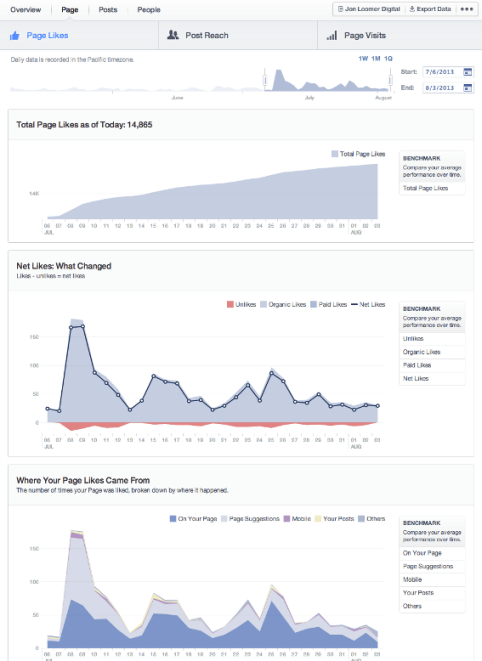
Facebook Insights
This is available for all page admins. It provides you with stats for your posts, your page fans and reach.

FB-insights


How to access: Click the “insights” tab located on the top of your Facebook page.
Twitter Analytics
This provides you with a 28-day overview of your performance on Twitter. It provides data regarding clicks, mentions, favorites, retweets and impressions. You can export data and generate a variety of reports.

twitter-analytics


How to access: Go to analytics.twitter.com and log in with your Twitter login.
LinkedIn (personal and business accounts)
LinkedIn collects data about personal and business profiles. For personal accounts, it provides you with data about who has viewed your profile, the reach of your posts, and more. For business profiles, it provides you with a breakdown of posts, followers, and network growth, including clicks, interactions, and engagement.

linkedin-analytics


To access personal page data: Go to profile and click on “who’s viewed your profile” in the dropdown menu.
To access business page data: Go to your business page and click on “analytics.”
Pinterest Analytics
The Pinterest dashboard provides insights into followers, impressions, audience stats and engagement. You can view detailed reports to gain a better understanding of which boards and posts perform best. Analytics are available for personal and business pages.

pin-impressions


How to access: Go to analytics.pinterest.com and login with your Pinterest login.
Google+ Insights
Google+ provides insights about your audience, engagement, and visibility for your personal and business pages.
google-insights


How to access: From your Google+ page, click the “Manage Page” button and scroll down to the insights section.
Third Party Social Analytics Tools
There is no shortage of high quality social media analytics tools available. Some are available for free with options to upgrade, and some are available for a monthly subscription fee.
Google Analytics
Google Analytics is not only for your website. You can also use it to measure social analytics for your website through social reports. The reports help you assess referral traffic from social networks, review content that is best to share, assess how visits from specific social platforms behave on your website and more.
Buffer
Buffer offers both a free and a paid plan. With its free plan, you can track engagement stats for your posts on Facebook, Twitter, Google+, and LinkedIn. You can also write and schedule posts, and you can use its link shortener to track the links’ performance.
Moz Analytics
A popular SEO tool, Moz Pro also provides you with built-in social media analytics to track your social media marketing efforts. You can breakdown traffic by social network and engagement. It supports Facebook, Twitter, and Google+. It is a fee-based subscription.
Websitehttp://moz.com/
SproutSocial
SproutSocial provides you with the best of both worlds – a social media management platform and analytics in one. It allows you to publish posts, track them, and view key data to help you better optimize your social campaigns. Analytics reports can be custom branded and exported.
Social Analytics
Social Analytics allows you to map your social reach and provides you with in-depth social data about your users, social reach and marketing efforts. You can import data from all major social networks you use.

Other Social Tools Worth Trying

4 Social Media Analytics Tips For Newbies

Here are some social media analytics tips to help you in your quest to master social analytics and become a social media star:
  1. You don’t have to measure everything: Measure what matters and what will help you achieve your business goals. Don’t get caught in analysis paralysis.
  2. Understand what you’re measuring: Numbers are meaningless if you don’t know why they’re relevant and how they can help you achieve your business or personal social media goals.
  3. Choose a select few social analytics tools that work for you: You don’t need to use all of them. Try out a few tools and use the ones that make the most sense for your business or personal needs.
  4. Look at social analytics from a holistic perspective: Avoid focusing solely on a single form of measurement. Think about things from a broad perspective and consider all the metrics you have access to.
What we’re trying to say is…
Social media monitoring should be approached with your business goals in mind. Use the above analytics tutorial and social media analytics tips as a starting point for integrating social analytics into your marketing and business strategy. Use social data to drive decisions about your brand’s online presence, how to better target and engage users, and how to improve your overall online marketing strategy.