Showing posts with label analysis. Show all posts

Friday, 18 March 2016

8 Elements Behind Every Successful Social Media Campaign


Sunday, 29 November 2015

How to Kill it with Instagram Marketing

Image result for instagram logo


Are you using Instagram to its fullest potential?
If you have a visually striking product or brand (and even if you don’t!) and you’re not on Instagram, you’re missing out on one of the biggest visual trends on social media today. And considering that images are often the most engaging aspect of social posts, that’s saying something.
Whether you’re new to Instagram marketing or you’re struggling to find the ROI of your photos, we’ve got a four-step process to help you kill it with Instagram marketing.
Step 1: Pre-Campaign Data and Insights
If you want to find success on Instagram, you’ve got to do more than just publish beautiful photographs. Your strategic thinking should begin well before you post a single image.
Before launching an Instagram campaign, consider exploring all of your available data and insights. What do you know about your audience? Who are they? What is their browsing behavior like? Where do they shop? What is their lifestyle?
If you are using a social insights platform, you should be able to apply what you know about your audience on other channels, like Twitter or Facebook, to your Instagram marketing to give yourself a great head start.
Step 2: Campaign Execution
Now it’s time to launch your campaign: Snap photos, create captions, insert hashtags and engage your audience.
Be sure that your bio is completely filled out, and that you are posting fresh, new content on a regular basis. Whether you’re running a one-off seasonal campaign or a long-term brand awareness campaign, you’ll need to keep your presence active in order to be successful.
Some tips for great Instagram photos:

  • Set your smartphone camera settings to “square” if available, so that all the photos you snap will be Instagram-friendly
  • Drive traffic to your website by always including a URL in your caption
  • Plan your Instagram photos in tandem with other posts across your social networks
  • Encourage your community to share photos of your product, using a branded hashtag
Step 3: Post-Campaign Measurement
After your campaign, or (better yet) at regular intervals while it’s running, you’ll want to capture metrics that show how successful your efforts have been.
Examples of Instagram metrics:
  • Number of comments
  • Number of likes
  • Number of followers
  • URL clicks
  • Branded hashtag mentions
What you measure will be determined by the goals of your campaign. Is it to drive traffic? Measure URL clicks. Brand awareness? You might want to look at comment sentiment and hashtags.
Step 4: Analysis
No social media strategy is complete without analysis. During your campaign, be sure to check in on the metrics you’ve decided to measure, and see whether they’re indicating growth.
You can analyze the demographic and psychographic makeup of your audience; the reasons why certain images performed better than others; what time of day gets the most engagement and more.
Analysis is a key component of a great Instagram strategy, as even not-so-successful campaigns can teach you what works and what doesn’t. By feeding this information back into your strategy for the next campaign, you’ll be in a better position to reach and engage your audience with your beautiful photos.
Try applying these four steps to your next Instagram campaign to better connect your content with your audience, and get the most out of your branded visuals.

Monday, 20 July 2015

Social Media Analytics For Dummies: A Tutorial

Social media monitoring is one of the keys to your success online.
Social-Media-Analytics-For-Dummies


Without examining social media analytics and assessing the performance of your posts and social profiles, you are just playing a guessing game.
By guessing, you’re missing out on a serious understanding for your business—what content is and is not working.
Social data and metrics help you track your brand’s impact and reach online. It also helps you better engage your customers, build relationships, optimize your social media strategy and monitor your performance.

Importance Of Social Media Analytics

If you are using social media for business, you simply can’t ignore social media analytical data. Social media monitoring helps to develop a deeper understanding of how people are interacting with your brand, how they access and use your website, and what they are saying about you in the online community.

funnel

Analytics help you learn more about your customers. The more information you can collect about them, the better position you will be in to anticipate and serve their needs – whether it’s providing them with information they are seeking, answering a question, providing product and service options or helping them accomplish a task online.
The benefits of social analytics include:
  • More targeted posts and content
  • Saving money on advertising and marketing
  • A more optimized content marketing strategy
  • The ability to provide better customer service
  • The ability to see the ROI for your investment in social media


3 Key Social Media Monitoring Tasks

Overall, social media monitoring helps you accomplish 3 key tasks:
  1. Diagnose: Assess what is working and adjust your communication strategies and timing to improve results.
  2. Prioritize: Determine which content, social platforms, users, and other factors get priority. Use the social data to plan your strategies.
  3. Evaluate: Use the analytics data to determine the success of your strategy and overall value to your marketing strategy.
Now that you understand the importance of social analytics, let’s explore the different types of social media metrics you can measure.

Types Of Social Media Monitoring Metrics

One of the most important things to understand about social media analytics is that you can measure virtually anything, and many companies get caught up analyzing dozens and dozens of social media metrics. If you are just starting out, one of the best social media analytics tips to follow is that you can learn a lot by simply tracking the most important and popular metrics:
  • Conversions: Arguably the most important metric is conversions. From a social media perspective, a conversion is getting a user to take a desired action on your social media profiles. For example, on Facebook or LinkedIn, it could be commenting on a post; on Twitter, it could be a reply or retweet. Conversions are defined by you and can also include filling out an online form, signing up for your website, clicking through from social media to your website, or any other goal that helps you achieve your marketing objectives.
  • Reach: This is the size of the audience with which you are able to communicate. It can be defined on a per-post or overall reach basis.
  • Engagement: The total number of interactions (likes, shares, comments, +1s, retweets) on a post.
  • Impressions: This is how many people saw your post in their social media feeds.
  • Audience growth rate: The rate with which your social audience has grown in comparison to last week, month or year.
  • Visits vs unique visits: A comparison of the total number of visits and number of unique visitors who have not visited your site before.
  • Bounce rate: The number of people who land on your website and immediately leave your site.
  • Referral traffic: The amount of website traffic that is being driven from your social media accounts.
  • Influence scores: These scores provide you with a social rating of sorts based on your social media network and activity. Klout is perhaps the best known platform.
Naturally, some marketers prefer some metrics over others and believe some offer more value and insight. Some prefer clicks over retweets on Twitter, shares over likes, daily traffic over traffic on a per-post basis.
The important thing to keep in mind is to choose the metrics that provide you with the social data and information you need to make important business and marketing decisions.

Social Media Analytics Tools

There are two main ways you can approach social media monitoring: Using social media dashboards on the platforms themselves, or using third party social media analytics tools to track your campaigns.

Social Network Analytics Dashboards

All of the top social networks now have a built-in analytics dashboard for you to track your posts and campaigns:
Facebook Insights
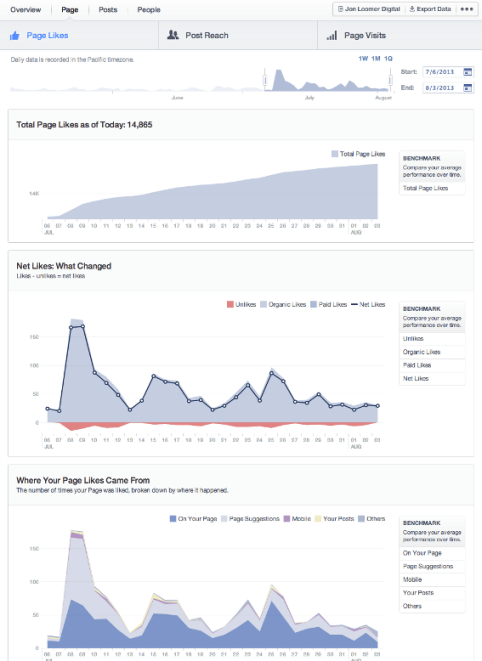
This is available for all page admins. It provides you with stats for your posts, your page fans and reach.

FB-insights


How to access: Click the “insights” tab located on the top of your Facebook page.
Twitter Analytics
This provides you with a 28-day overview of your performance on Twitter. It provides data regarding clicks, mentions, favorites, retweets and impressions. You can export data and generate a variety of reports.

twitter-analytics


How to access: Go to analytics.twitter.com and log in with your Twitter login.
LinkedIn (personal and business accounts)
LinkedIn collects data about personal and business profiles. For personal accounts, it provides you with data about who has viewed your profile, the reach of your posts, and more. For business profiles, it provides you with a breakdown of posts, followers, and network growth, including clicks, interactions, and engagement.

linkedin-analytics


To access personal page data: Go to profile and click on “who’s viewed your profile” in the dropdown menu.
To access business page data: Go to your business page and click on “analytics.”
Pinterest Analytics
The Pinterest dashboard provides insights into followers, impressions, audience stats and engagement. You can view detailed reports to gain a better understanding of which boards and posts perform best. Analytics are available for personal and business pages.

pin-impressions


How to access: Go to analytics.pinterest.com and login with your Pinterest login.
Google+ Insights
Google+ provides insights about your audience, engagement, and visibility for your personal and business pages.
google-insights


How to access: From your Google+ page, click the “Manage Page” button and scroll down to the insights section.
Third Party Social Analytics Tools
There is no shortage of high quality social media analytics tools available. Some are available for free with options to upgrade, and some are available for a monthly subscription fee.
Google Analytics
Google Analytics is not only for your website. You can also use it to measure social analytics for your website through social reports. The reports help you assess referral traffic from social networks, review content that is best to share, assess how visits from specific social platforms behave on your website and more.
Buffer
Buffer offers both a free and a paid plan. With its free plan, you can track engagement stats for your posts on Facebook, Twitter, Google+, and LinkedIn. You can also write and schedule posts, and you can use its link shortener to track the links’ performance.
Moz Analytics
A popular SEO tool, Moz Pro also provides you with built-in social media analytics to track your social media marketing efforts. You can breakdown traffic by social network and engagement. It supports Facebook, Twitter, and Google+. It is a fee-based subscription.
Websitehttp://moz.com/
SproutSocial
SproutSocial provides you with the best of both worlds – a social media management platform and analytics in one. It allows you to publish posts, track them, and view key data to help you better optimize your social campaigns. Analytics reports can be custom branded and exported.
Social Analytics
Social Analytics allows you to map your social reach and provides you with in-depth social data about your users, social reach and marketing efforts. You can import data from all major social networks you use.

Other Social Tools Worth Trying

4 Social Media Analytics Tips For Newbies

Here are some social media analytics tips to help you in your quest to master social analytics and become a social media star:
  1. You don’t have to measure everything: Measure what matters and what will help you achieve your business goals. Don’t get caught in analysis paralysis.
  2. Understand what you’re measuring: Numbers are meaningless if you don’t know why they’re relevant and how they can help you achieve your business or personal social media goals.
  3. Choose a select few social analytics tools that work for you: You don’t need to use all of them. Try out a few tools and use the ones that make the most sense for your business or personal needs.
  4. Look at social analytics from a holistic perspective: Avoid focusing solely on a single form of measurement. Think about things from a broad perspective and consider all the metrics you have access to.
What we’re trying to say is…
Social media monitoring should be approached with your business goals in mind. Use the above analytics tutorial and social media analytics tips as a starting point for integrating social analytics into your marketing and business strategy. Use social data to drive decisions about your brand’s online presence, how to better target and engage users, and how to improve your overall online marketing strategy.

Saturday, 29 November 2014


Study says social-media analyses are off target


Rigorous methodologies, sophisticated analytic engines can still be wrong if no one corrects for flaws in data fed to them.


The things people say on Twitter or share on Facebook are pretty trivial individually.

When you collect the 5 billion or so items posted to Facebook, Twitter and other social networks every dayinto one massive database, those bits of individual drivel combine into a massive pointillist masterpiece that is already changing the way governments and corporationsrelate to individual humans, allowing marketers to tailor products more precisely to the customer preferences (and target spam campaigns more effectively) with up to the minute insight into the thinking of their constituents.

Deep analysis of social-network data has changed online marketing so quickly that senior-level marketing executives are still struggling to come to grips with their new power to analyze customers, according to the CMO Council that represents them.

Which is a shame, because the picture all those petabytes of badly spellchecked musings provide of the thoughts or preferences of actual customers is mostly wrong, according to a study published in today's issue of the journal Science.

The problem isn't with the data; the problem is with the way data is presented and analyzed, according to the article's authors, Derek Ruths of McGill University and Jurgen Pfeffer of Carnegie Mellon.

Social-media datasets often munge together all those personal revelations into a big picture without correcting for things that make a big difference in their accuracy – like the demographic differences between social network populations, the type of information usually posted on each the number of bots and spammers pretending to be human users and even the effect of the site design on the tone of the content posted.

Facebook, which is the single largest contributor to the social-network-data universe, has a Like button but not a Dislike button, which makes it harder to detect a negative reaction to a particular piece of data, the two argue.

Specifically:

Facebook, which is used by about 71 percent of Americans skews significantly female, young and (relatively) lower income, according to December, 2013 survey by the Pew Research Center. Seventy-six percent of women polled use Facebook compared to 66 percent of men; 84 percent of those between the ages of 18 and 29 use Facebook, as did 76 percent of those with incomes under $50,000 per year.

Twitter is almost gender balanced, but twice as many African-American respondents said they Tweet than either white or Latino, and its user numbers skew far more heavily toward those in the 18-29-year-old age group (31 percent) than Facebook.

Instagram is 28 percent more female than male, but is far less skewed than Pinterest, which attracts five times more women than men.

LinkedIn is more male than female (24 percent to 19 percent) and more black than white but skews drastically toward the middle ages (30 years old to 64 years old), college-educated and upper income (38 percent make $75,000 per year or more).

Researchers and service firms that collect, clean and sell social-media data sets often slot users into easy-to-identify groups according to age, income and other variables, which make the data look more consistent than the users they came from, according to Ruths and Pfeffer.

Even worse are reports that use smoothed-over data with analytics that are a little too smug to infer things like a user's political affiliation.

Even using analysis methods that are "sound and often methodologically novel," Ruths and a co-author wrote in an earlier paper, "reported accuracies have been systematically overoptimistic due to the way in which the validation datasets have been collected."

The real accuracy levels for political affiliation are closer to 65 percent than the oft-reported 90- percent Ruths and Pfeffer wrote.

Far from being unfixable, however, miscalculations in social-media analyses can already be fixed using methods developed to fix similar problems in studies in epidemiology, statistics and machine learning.

"The common thread in all these issues is the need for researchers to be more acutely aware of what they're actually analyzing when working with social media data," according to Ruth, who compared social-media mis-analysis to the flaw in survey methodology that produced the "Dewey Defeats Truman" headline from the 1948 Presidential election. That survey, which was done by telephone, drastically underestimated the number of Truman supporters, many of whom, in the days before telephones became ubiquitous even in rural areas, didn't have phones.

"We’re poised at a similar technological inflection point. By tackling the issues we face, we’ll be able to realize the tremendous potential for good promised by social media-based research," Ruths said in a McGill press release about the paper's publication.

Fortunately for marketers hoping to produce social-media analyses with results that won't send their companies racing off in very close to the right direction, there are already projects underway to fix social media's identity problem.

In October Twitter announced it was giving the MIT Media a $10 million grant and the promise of a real-time public feed of Twitter data to create analytical tools that would bring deeper, more accurate insights into the meaning of billions of Tweets.

The Social Media Research Group at the Queensland University of Technology in Brisbane, Australia have actually come out with a Web-based platform with algorithms specifically designed to provide an "academically rigorous" analysis of social-network data.

The online service, which is available to a few early testers but is otherwise still under development, was announced Nov. 11.

"We want to move the analytics discussion beyond counts such as likes, favorites and retweets into prompting action based on real-time content and metrics placed in national and industry contexts," according to an announcement quoting co-developer Darryl Woodford, a research fellow at the university.