Showing posts with label blogging. Show all posts

Monday, 11 January 2016

3 Killer Strategies to Get Your Readers Benefit From Your Blog!


Source

Sunday, 20 December 2015

The Recipe for an Award-Winning Content Dish [Infographic]

Blog content plays a very vital role in generating B2B leads as much as drawing awareness towards your product. Much like cooking stew worthy of Gordon Ramsay, mixing the right content maximizes the appeal of your blog, urging people to come back for more.

In this infographic, we explore the most important content types to add to your blogging recipe.


1-2 Cups of Infographics

You can’t have a blog without producing visual material at least once a month. So, start researching for infographic ideas and share them across different social media.


Did you know? 40% of people respond better to visual information than plain text.
Here’s how to perfectly start your infographic.

A Dash of Video

An informative video that is worth a prospect’s time is at any rate a good lead generation device. For best results, make it stand out and insert a highly engaging call-to-action.
Did you know? By 2017, 74% of total internet traffic will be video.

A Slice of Whitepaper

Too technical? Nah! Whitepapers are in fact effective in pushing potential leads to engage you. Just get your facts straight and your details hard.
Did you know? Whitepapers can also be shared with companies as reference material for industry research projects.

2 Tablespoons of Embedded Tweets

Using embedded tweets, promote yours and other people’s content. Aside from giving your engagement rates a boost, it also gains the affection of the influencers whose “tweets” you shared.
Did you know? About 34% of marketers use Twitter to generate leads. 

3 Pieces of Quality Articles

Delivering quality articles is no doubt an important strategy for increasing traffic. Pay attention to important keywords and focus more on solving problems than on merely giving your insights.
Did you know? At least 81% of B2B companies use blog articles for driving quality traffic.

2 Servings of Case Studies

Narrow your case studies down to the most serious problems. Now, tell how your company was able to solve them by using a storytelling formula that leads from the problem to its corresponding resolution.
Did you know? Along with whitepapers and other technical documents, case studies are proven to increase your credibility and brand image. 

A Whole Lot of TLC

Don’t rush! Spend a great deal of time coming up with quality content ideas. Let them simmer for a while and take extra care to making them extra special just for your audience.
Read the original article on Callbox Blog.


Wednesday, 14 October 2015

Digital Content Consumption: How Well Do You Know Your Audience?


“How well do you know your audience?” This is a question that many of us writers and content creators take to heart since the very early stages of our professional training. Unfortunately, as content marketing gains popularity, we find ourselves caught in a race that has nothing to do with engaging the reader but to churn out x number of content a week (if you’re lucky). For some writers on news and community websites, you’re faced with the challenge of writing as many as ten articles a day even.
This type of volume-based writing is more for the SEO-writer but not for the other types of writer. Apparently there are many writing styles that got neglected in the online world such as descriptive writing, narrative writing, persuasive writing, and technical writing.
Let’s take a peek into consumer psychology. Quite obviously, if you’re writing for a middle schooler, you’d want to use a different tone of voice and choice of vocabulary as oppose to writing for someone in their thirties. The concept is essentially the same when writing for consumers of a brand. The only difference is that when you’re working for big brands, the scale at which you would want to understand your audience becomes enormously important.
Millennials, Generation X and Baby Boomers
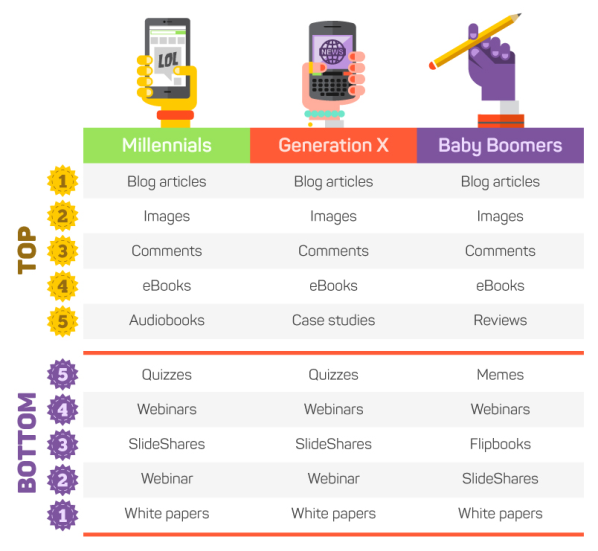
Let’s begin by splitting your audience by age group: the Millennials, Generation X and Baby Boomers. A recent research by BuzzStream and Fractl identified that the top 4 content types for all three segments are the same. The takeaway? You definitely don’t want to skip blogging and using images whenever there’s the opportunity.

content consumption
source: socialmediatoday.com
You Won’t Finish This Article

The headline of this section says it all. Online readers just do not invest time to read every single word of an article. Does that mean you should be stuffing everything that is important in the first two paragraphs? Probably not. That would only jeopardize your article quality and flow.
Instead, make good use of headlines and sub-headings. Regardless of the medium, whether it’s a newspaper print, pocket book or online article, headlines, titles and chapter headings will always capture the reader’s attention first.
For online writing, good use of sub-headings would mean audiences have more freedom to jump between parts of the article. It also helps to make the article more digestible.
Finally, if the consensus is that many online readers rarely complete reading a whole article, most likely they would jump to the very ending for the conclusion. This makes the last paragraph very important. Whenever possible, make it a habit to sum up the entire article into a concise last paragraph.
The Multi-Tasker
There is no denying that a large portion of online content consumption now happens on mobile devices and portables. (Yes, I know that you know that mobile is important and you already have a plan that involves responsive websites, faster rendering and so on.)
Besides the technicalities, for the writer, it’s worth to note that the audience behavior when consuming content on mobile and on desktop is significantly different. Hence, there is more to content optimization for mobile readability than the standard layout and appearance. For the writer, you’re in fact optimizing your content style and writing to meet the multi-tasker-type audience. While desktop readers may multitask by switching between two tabs, or have some music running in the background, the mobile reader is commuting on public transport, having lunch, running on the treadmill or even while walking in the park.
In China, there is even a phone lane for those whose attention is split between consuming content on their mobile phones or chatting, while also commuting.
The takeaway? For long articles, the audience may quickly lose their spot when they are multi-tasking. Use lots of images and sub-headlines to act as breaks and bookmarks. The use of slimmer paragraphs would also make long articles more digestible.
Headline Skimming and Image Scanning
Online reading behavior is simply different from offline reading. Reading print encourages you to really focus on what you’re reading while digital reading tends to be more of a surface-level reading. The rise of social media, that basically works around images and text snippets further influence this habit to skim headlines, scan through a few keywords and scroll over images.
The takeaway? Similar to the previous section, you’ll want to make sure your headline stands out and do make use of sub-headings. Since most headlines will appear in bold, a larger font-size or different color, when your audience skims through the article, these headlines will stand out and encourage the reader to continue skimming through. Is skimming bad? As a reading behavior, most probably yes. For those who are tight on time (which is quickly becoming the norms for many people), it’s a great skill to have. For brands, making good use of headlines and images may just be the deciding factor whether your content marketing sees fruition.
So How Well Do You Know Your Audience?
In summary, research pinpoints that regardless of age group; most online content consumers prefer blog articles and images. The increase use of mobile devices for internet browsing nevertheless puts forth new challenges. Long articles can be made to flow better and easier to digest by the use of sub-headings and slimmer paragraphs.
While this article focuses on the behavior of consumers when it comes to reading online content, other factors that may determine the success of your content development strategy is of course, to also have a clear understanding of your brand’s products and services.

Source

Thursday, 8 October 2015

Blogging: Stop Following, Start Exploring

The title “Stop following. Start Exploring.” is the slogan for a popular Indian educational portal Shiksha (means education), but it also holds true for bloggers. As a newbie bloggers, most of us start with choosing a niche for our blogs. Some of us don’t even know what niche we should choose. Whether, it should be a multi-niche blog or  a single niche blog, etc.  Now even if you somehow figure out the niche you are interested in and created a blog with related domain name, the next step is to curate contents for the blog.
Stop Following, Start Exploring for the sake of your Blog
The old saying in the blogging world is “content is the king”. But, how true is that? I would say very true and content is the only thing, which differentiate your blog from the millions of blogs on the internet. Now to create contents for your blog, the popular method is to bookmark popular websites related to your niche and try to figure out what is working for them and what is not. For example, if you are interested in gadget niche you may follow something like GSMArenaAnandtechPhonecurrent and create a similar website.
Bookmarking popular websites isn’t a bad idea nor analyzing them. However, following them extensively to the core where you start focusing on only a few popular blogs and trying to be like them will not take you anywhere. After a year of blogging, you will find yourself nowhere in the crowd and you may ultimately quit blogging. And the popular blogs which you were following w
Why? Because, you chose to follow them, and they chose to explore.

#Stop Following 

No popular websites on any niche became popular overnight. There are various factors, which have contributed to their success. They have started early, they chose a niche which wasn’t populated by that time and most of them are godfathers of their niche. They started from the scratch and were really passionate about what they are doing.
Now among all these factors, there is one more thing which has made them what  they are now. Now, before I spill the beans, let me ask you one thing.
Which popular blogs, those bloggers used to follow? Note that there weren’t many popular blogs that time and almost everyone was a beginner.
The answer is none. Instead of following anything, they choose to explore things, which were related to their niche. They still do the same and we still do the same as well. That is following them.
I began my blogging journey with the same attitude of following some of the most popular blogs related to technology niche. I started as a writer for tech blogs, which helped in learning about blogging. Later, I created my own blog in the technology niche. Fortunately, after 6 months of blogging I was in better position than most of the tech bloggers in the same field who started even before a year than my blog went live.
You may call it a luck or just coincidence, I was able to choose topics, which were low competitive as well as had high search volume without using any SEO software. I did apply some basic SEO techniques, which worked perfectly well with the blog. After 8 months of blogging, the blog was getting around 300K pageviews a month, among which 90% of the traffic was organic, 2% from social media and 8% from referral.
Woohoo, happy ending, right? Nope.
Now after 2 years of starting the blog, the blog is still in a strong position, but couldn’t bring the satisfaction a genuine blogger will look from his blog. If I ask myself how exactly is my blog different from thousands of other technology blogs on the internet? How many topics I started before anyone in the web world and found solutions for them? well, I barely could answer anything. Except the fact that it has grown large, brings good revenue and I never applied any Black hack techniques. Is that enough? Well, at least not for me.

#Start Exploring 

Since I keep creating new blogs every now and then, this time I thought of building a blog, which purely contains solutions or topics discovered by me (mostly). The blog is Technicalnotes and as the name indicates, it is a tech blog and technology is the niche I love.
For this blog, I stopped following and started exploring. I also did not use any off page SEO tactics to make it achieve good rankings in search results. It wasn’t necessary because the contents in the blog were first to be published in any blog on the internet. As far as link building is concerned, if you are the first one to publish anything important, the links will flow automatically as the popular tech blogs will pick your contents and link back to them as reference or source. Basically, you are making them follow you, instead of following them.
Now talking about the result so far (though, it’s too early), in last few months the blog has grown much faster than I thought and the results are impressive. It has quality  and unique posts. The links coming to the blog are natural and at the end of the day you will have something original, which you have created by exploring things instead of following.
Conclusion 
If you are a newbie, have started blogging in 2015-2016 and looking for a long-term goal, I would recommend you to start exploring things on your own than simply following the footsteps of the popular. Try to create your own contents, do extensive research and then publish your post. It may look difficult in the beginning, but you will grow to be a much experienced and mature blogger with an opinion over the years.
Blogging is a crowded place with more number of spammers coming with new tactics to trick the Google algorithm every day. Now if you don’t create a unique blog with unique contents, then there is no reason for Google to rank your blog higher than the blogs which has contents similar to your blog and have published it before you could. And the possibility is that Google may just destroy all your hard work by penalizing it for the crime you didn’t commit while targetting the spammy blogs. Now it’s completely your choice to create something which is worth having and boosting about or just follow the masses.

Source

Friday, 25 September 2015

6 Content Marketing Hacks: A Cheat Sheet for Marketing Managers

content-marketing-hacks-is

In the  past, the term “hack” had a very different meaning. Back then, a hack was someone who wasn’t very good at their job. They either phoned in their work every day or simply lacked the talent to do good work in the first place. No one wants to be known as that sort of “hack,” which the Merriam-Webster Dictionary defines as “working for hire…with mediocre standards.”

These days, hacks are much cooler. Instead of putting out huge volumes of mediocre work, they make the complex seem simple and the impossible seem possible. Modern hacks are most definitely our friends. (Not including those who “hack” others computers! Totally different type of hack!)
Let’s explore six content marketing hacks that could dramatically improve your lead generation and conversion metrics.

1. Test Headlines and Above-the-Fold Content

Check out the latest studies on Web users’ attention spans. Depending on who you ask, the typical Internet surfer takes anywhere from one to seven seconds to make a final decision about whether to remain on a particular website or navigate away. Basically, your average prospect could decide to leave your website before the homepage is done loading.
How can you get more first-time and repeat visitors to stick around? For starters, craft short, catchy headlines that attract the attention of visitors and fully display in search results. Most engines display a maximum of about 60 characters – enough for about seven to nine words with spaces. Your headlines don’t have to be uniformly sensational, but they should be intriguing enough to convince people to keep reading.
You should also focus on engaging graphics, images, video, text formatting, and navigation features in each page’s “above the fold” area. Traditionally, the “above the fold” portion of a website is the area visible without scrolling once the page has completely loaded.

2. Go Deep!

Until recently, conventional wisdom has held that blog posts and most other forms of non-gated content perform best when they’re short, sweet, and to the point.
There’s certainly some truth to this notion. If you’re announcing a snippet of company news on your blog or touting a limited-time offer in a snappy press release, it’s probably best not to beat around the bush too much.
On the other hand, truly effective content marketing is often fearsomely comprehensive. Nothing conveys authority and subject-matter mastery like a 2,000-word whitepaper on a particular aspect of your business or trend affecting your industry, particularly if you’re the first thought leader to write at length on the subject.

3. Offer Something of Value

Although long-form content marketing shouldn’t be gated for profit by default, it’s important not to give away every single piece of content you produce.
Get in the habit of putting together a major piece of authoritative content – a comprehensive series of case studies, an exhaustive white paper, even a professionally produced video.. Then use secondary content, such as shorter blog posts and email marketing blasts, to promote the primary piece of content extensively.
Unless content creation is a key part of your business model, you don’t have to charge a fee for users to access the content. However, you shouldn’t make it freely accessible from an unrestricted site page. Instead, offer it up as a downloadable PDF and require users to provide their name and email address before viewing it. If your organization puts on admission-only events from time to time, consider offering the content to anyone who purchases a ticket to your next get-together.
Setting “tent pole” pieces of content apart from more routinely scheduled blog posts and emails is a great way to make them seem special – and to create the impression of value for your prospects. Remember, prospects who feel as if you provide them with actionable, valuable intelligence are more likely to become paying customers.

4. Make Sharing Seamless

In the age of 24/7 social media, nothing holds users’ attention like seamless sharing capabilities. Depending on the nature of your company, you’ll want to include sharing buttons for your strongest social platforms.
Whereas B2B companies typically feature LinkedIn, Twitter, and Google Plus buttons prominently, B2C firms may have more success with platforms like Facebook, Pinterest, Snapchat, and Instagram. Share your own content, plus relevant curated content from other sources. And don’t forget to ask your audience to share your content with their friends and followers as well.

5. Sharpen Your Calls-to-Action

Make sure you compose top-notch calls-to-action for each type – or even each individual piece – of content that you produce.
Some businesses find success with campaign-specific calls-to-action directing the website visitor to take a specific action on the website i.e. download a white paper, read a blog article, subscribe to an email newsletter, etc. All of these can be useful for segmenting different customer groups into parallel email marketing lists that you can nurture into leads through ongoing email marketing.

6. Don’t Discount Guest Blogging

While the subject of guest blogging has been debated whether or not it’s a valuable SEO tool, it’s still a critical component of content marketing. Instead of link-building, guest blogging is now primarily used to build authority among target audiences and indirectly drive traffic back to a particular website. As long as your guest posts use “nofollow” links, you’re likely to see a qualified traffic boost from a sustained campaign.

Learn How Content Marketing Works from the Pros

If you can keep these content marketing hacks straight as you architect your online marketing campaigns, you’ll be well on your way to success. That said, the world of content marketing is confusing – even when you’ve got the hacks to help you out – and can change in the blink of the eye. Don’t be shy about asking for marketing manager tips along the way. We’re here for you!

Source

Saturday, 19 September 2015

Where Does Blogging Fit Into Your Content Marketing Strategy?


blogging
If you’re in marketing, you know two of the largest buzzwords in recent years are “content marketing” and “blogging.” But how do you develop a content marketing strategy and where does blogging fit into that plan? Read on to find out.


Before you begin, it’s important to get the basics down first. Companies may define aspects of their content marketing strategy differently, but the concept is generally the same:
  1. Set content marketing S.M.A.R.T. goals. Don’t dream about your goals, put a plan in place to achieve them. To ensure you stay on track, make your goals specific, measurable, achievable, realistic, and timely.
  2. Define your buyer personas. As defined by HubSpot, a buyer persona is a semi-fictional representation of your ideal customer based off research and data from your company’s current customers. The better you know your persona, the more successful you’ll be in your content marketing efforts.
  3. Decide which type of content works best for your business. Based of your buyer persona(s), decide which content will resonate best with them like blogging, ebooks, white papers, podcasts, etc.
  4. Create an editorial calendar. Once you have the type of content you want to create, it’s imperative you put a plan of attack in place to develop and promote this content. Scheduling plans out at least 90 days in advance will help to ensure you’re on track.
  5. Market your marketing. What good is your amazing content if nobody knows about it? Get it into the hands of your buyer personas through social media, email, blog (SEO efforts), and so on.
  6. Measure your results. The beauty of digital marketing is that it’s so easy to monitor your results. Keep an eye on your analytics and base your efforts moving forward on those results. See what works and what doesn’t and optimize from there.
So where does blogging fit into this content marketing strategy? You’ll find that no matter what your business is, blogging will work well for your company! Blogging should be used as an awareness-stage piece of content that educates your audience and answers questions and pain points they may have. Blogging contributes significantly to your content marketing strategy by providing the following benefits:
  1. It helps to drive traffic to your website. Every time you write a new blog post you’re adding another indexed page to your site, which Google and other search engines love! It proves your website is active. Each page you add gives you another chance to be found in search results (which is how most people look for content these days).
  2. Blogging can get you discovered on social media. If you create great content on your blog, people will want to share it via social media (you should share it on social as well to your personas). The more people share, the more visits you’ll get, and the more it will help your SEO results.
  3. Blogging increases conversion. How you may ask? You can add lead-generating CTAs to your blog posts that direct to landing pages with relevant content and offers your visitors can convert on. The more blogs you have, the more people will see you CTAs, which increases the odds of conversion. More site visits and more leads? Blogging is a win-win.
  4. Blogging establishes authority. If your answering common questions and solving your persona’s pain points in your blogs, people will start to look at you as a leader in the industry and will begin to trust your company. The more a person trusts your company, the more likely they’ll be to turn into a customer someday.
Blogging is a no-brainer when it comes to your content marketing strategy and fit’s into your plan from the beginning. No company is too small to not blog and no company is too large. How has blogging helped with your content marketing strategy?

Source:

Monday, 7 September 2015

10 Tips For Repurposing Your Old Content

We all have a myriad of blogs on our sites that are no longer utilised and tend to just sit there gathering dust.
Aside from receiving the odd view or comment, older content often tends to get overlooked – partially because it’s out dated and also partially because Google tends to prefer newer indexed material.
However, this doesn’t mean it should go to waste and there are numerous ways that you can repurpose old content and give it a new lease of life, allowing you to get more from it. You’ve done most of the research already – so update, change the format and reap the rewards – here is how to do so.

Old Material Refreshed

The archives of your blog content contains a plethora of information that can easily be reused. That content has already been tested and you know what has done well for you, so it gives you good idea of what you can reuse successfully.
Instead of reusing the same article, give it new life by adding some tidbits of new information or adding some small details that it was missing before. This will not only give you a basic template to use to write some content, but it also gives you content that you know has worked very well in the past.
Think about college textbooks. The basic structure of the book doesn't change from year to year, but new information is simply added to the already useful content. This provides companies with a quick turnaround and the ability to charge a little more for the textbook.

Transform Blog Posts into SlideShare Presentations

Taking those blog posts and transforming them into SlideShare presentations will open the door to increased traffic and some new leads. Since SlideShare has such a growing community, you will expose yourself to new viewers and potential customers. The key to great Slideshare posts is a mix of great, well-chosen imagery and well presented, informative content.
Remember, when saving your infographics to a SlideShare, it must be saved in a one-page PDF format before you upload it. SlideShare will then automatically detect it as an infographic and list it in the infographic directory.

Create Tutorials Out Of Webinars

After hosting a successful webinar, you can take the information shared on the webinar and transform it into a tutorial. Since many people won't be able to make it to the webinar, you will have missed a ton of potential leads.
Use YouTube to repost the webinar. This will provide an evergreen form of content provision that is available for anyone and everyone to see. The expanded audience can drive even more traffic to your site quickly.

Start a Newsletter

Sending out a newsletter to your clients can help introduce them to content that they may be interested in. When using outside articles for the content of the newsletter, be sure to give credit where credit is due and site your sources.

Turn Old Blog Posts into LinkedIn Publishing Posts

LinkedIn publishing has proven to be quite effective for many companies. Taking your evergreen content from your blog and posting it to LinkedIn publishing will make your content more visible and allow you to summarize and highlight the most important and interesting parts of the post. Then, you can link the post back to your blog and draw in the new traffic.

Take Advantage of Quora Q&A

Many content writers gain a lot of inspiration from Quora Q&A. This site provides questions that real users have and the answers they seek within a wide range of categories.
To use Quora to your benefit, find a question that has several upvotes. This shows that the answer is high in demand and that many users are interested in learning more about it. Create a blog post answering that question, answer the question on Quora and provide a link that directs the readers to your blog post. Here are some great tips fromBuffer.
This will draw in new traffic and increase your standings within the community.

Create a Case Study

You know what your viewers have liked in the past. Take the information that they have enjoyed and turn it into a case study. Include some stats, research results and solutions that can help your clients find the answers that they are looking for.

Write Top Ten Lists

Lists do very well on the Internet. Take some excerpts from your most successful posts and create top ten lists out of them. You can then include links back to the original blog post and draw traffic to your site. Check out this great guide on how to do so from Search Engine Watch.

Snippets Of Old Posts

Some of the most attractive content isn't lengthy articles - rather it is snippets of those quality articles. Post snippets with links back to the original post to draw in traffic.
Old content can become new content without a lot of effort and these ten ideas will help you do so easily, allowing you to get more value from your content.
Cormac Reynolds is an advocate of smarter and more engaging content marketing – when he’s not creating his next great piece for MyOnlineMarketer, or working on a new campaign for a client, he can be found making beer or listening to great music. 

Friday, 4 September 2015

35 Engaging Social Media Post Ideas For Businesses

Being involved in social media is great fun and very rewarding, and it is one of the best ways to market your business. But sometimes you can feel a little stuck when it comes to new ideas for posts and content on the various platforms.
We help you to combat this issue with this article, in which we look at 35 different post ideas for social media. If you do one every day, that’s over a month of great content that should allow you to stand out from the other businesses in your industry. Do one of these every other day, and you’ve got over two months of your social media content calendar worked out.
theme
So here are the ideas for your social media platforms. Enjoy.
1. Behind the scenes photos. These are used a lot by companies that want to show that they are a trustworthy and accessible brand. It’s best to keep it as natural as possible, and we suggest putting a twist on things, like ‘a week in the life’ for example.
2. Post up a funny or inspirational image. Make sure it fits in with the lifestyle and/or aspirations of your audience. Be sure to include your logo on the image somewhere as well. A picture can be better than a thousand words, so choose wisely and it could be a real engagement tool.
3. Use an infographic. You don’t need to make your own by the way. Find one that your followers would really like to see and which provides value, and then put it out there.
4. Grab a great product photo and use this on social media. Many companies find this is a way to gain great exposure for your product (it’s in the picture) as well as gain some real social proof as the customer or client uses the product or service. Make it as natural as you can, otherwise it will look like a staged effort.
5. You could also include photos or videos that literally have nothing to do with your product directly, but instead have resonance with your audience. This means showing an image of a pair of interlocked hands to link to that romantic break you’re offering customers, for example. It creates a little bit of intrigue and it also makes your company appear less like a pushy sales organisation.
6. Going back to those product shots again. If you manufacture stuff, show people how it is done. Many a company has benefitted from showing images or videos of their production line or other parts of the manufacturing process. If you provide a service, show how it is created and delivered.
7. Case studies are excellent ways to bring variety and also a little extra marketing potential to your posts. Case studies need to be done right though, so spend time finding great customers to interview who have lots to say.
8. If you have people on your social media profile who are obviously fans of your product, share a photo of them on your channel. This allows you to make a connection with the audience you are reaching and also gain extra marketing potential.
9. If you want to give a little more to your audience and to ensure that you don’t come across as some desperate marketer, share a great book you have read recently. This allows you to show your mindset, and also that you and your company are human.
10. You could become even more creative with your post ideas and link to a ‘day in the life’ post that you have created. You could focus on one member of your team and get them to write a short post that details their working day. It works a treat for making your company more approachable, and it also allows you to bring even more engaging content to your audience.
11. You could ask questions. If you have a burning question that needs answering and your customers may be able to answer it, pose it. Ask a question and if it is interesting enough people will respond and therefore your community will build. It doesn’t take a lot of work and it allows you to keep that update flow going.
12. Take a look at some social media profiles in your industry that you like and recommend them to your following. This shows expertise and a sense of connectedness to your industry, and will also allow you to get some reading of your own done as you peruse these other profiles.
13. If you have a particular audience (as in female) then you will probably do well if you share a Pinterest board that the followers would like to learn more about. There are many opportunities here, and it shows that you are sharing for the value you can offer, rather than just sharing for sharing’s sake.
14. Find a customer who has stayed loyal for a long time and arrange for a full, professional video testimonial to be recorded. This is very effective because it has social proof and it is easy to take in.
15. Hold a contest. Some of the best contests involve customers taking photos of themselves using your product in unusual places for example. This means you get some real engagement, and if you have a prize you will get a great response. It builds up a sense of community and allows you to have an exciting post on your social media as more and more photos come in.
16. Have a debate. Post a question and then get people to answer and offer their own opinions. This can be a little tricky to manage, especially if the debate becomes a popular one. Monitor it as closely as possible and ensure that you stay on top of it and it could even provide you with content ideas for weeks to come.
17. Find a video that inspires you and your company and share it on your own social media channels. Pick one that will resonate with your audience and then just make a small, simple comment. It works wonders for reconnecting with your audience and it is of course easy to do.
18. As always, one of the best things you can do is to share industry news that is up to date and relevant to your audience. This makes for a much more engaged audience, and they will start to listen to you on the big topics of the day and latest news.
19. Create a simple but honest profile on an employee. Interview them perhaps, and put that interview out on social media. People like to see the human side of a company and this is a great way to do it.
20. Go deeper and find some research in your industry that you know will be of interest to your followers. This shows expertise. Then back it all up with plenty of data.
21. If your company has received an award or quality mark, share the news in a post. Make it a clear and factual post and this shows you are not bragging, but are instead just informing your audience of the quality you produce.
22. Share company news that is important not just to your employees but also the audience you communicate with regularly.
23. Create a series of posts and run them over a week. This is a great way to keep readership up, and it also shows that you are developing thought leader status.
24. Host a hangout on Google+. This is a great way to talk to your customers, and a transcript of the Hangout can be produced and given away as part of your social media management. Make it a fun one that is important to your audience and you’re flying.
25. Give away product. If you get your fans to comment or post an entry, give them something free in return. This is a great way to build up engagement, and also to populate your social media.
26. Interview an industry expert and link to it or post it on social media. This is a great way to build up that expertise level.
27. Tease your audience with a snippet for an upcoming blog post that you’ve been working hard on. This builds anticipation in your social media following.
28. Check out your FAQs and think of a new question that you get asked a lot but is not included in your FAQs. Answer the question or series of questions and then use this for your posts.
29. If you know some great groups on LinkedIn, and the group is sharing valuable content with some excellent conversations, then link to the group. This makes for an excellent resource for your followers.
30. Check out what your competitors are doing and share some of the same stuff they are. It shows that you are looking at your industry and showing respect to your competitors. You can even credit them as well. It also shows that you are confident in what you do, confident enough to share your competitor’s best stuff.
31. Take a look at your social media analytics and work out what is being engaged with the most and share more stuff that is in a similar vein. This is a classic way to build up even more engagement.
32. Find a blog post that you have read recently that was really successful and take the best snippet you can from it. Then share that snippet as part of your social media with a link to the post.
33. Share tips and tricks that will make the lives of your customers better. This is value-sharing at its best.
34. For even more fun, take a photo of your desk (tidy, of course) and show what you can’t be without on a typical working day. This brings more engagement and a sense of fun and personality to your company.
35. Create a tutorial on a particularly tricky part of your product offering or industry. Make it using video if you can, or an excellent quality infographic. This is where social media first started, in offering value. So go offer value.
Those are just some ideas on how you can create new and exciting content regularly for your social media platforms. The best thing is they are all easy to do, and you should be able to put something together quickly in most of these cases.
Creating rich and varied content regularly is important in social media. Use the above to stay one step ahead of that game.
To stay even further ahead of that game, you need high quality data and metrics at the push of a button. Try LocoWise for a free trial to get the most out of your social. Find data quickly on all aspects of your social media within seconds (and look at some very beautiful charts at the same time).