Showing posts with label china. Show all posts

Friday, 2 January 2015

Here’s How Chat Apps Are Becoming As Important As Social Media For Brands


A number of top pundits are predicting that messaging apps will become ‘the new social media’ in 2015, and here’s some evidence to support that theory from Line, the chat app from Japan with over 500 million registered users and 170 million monthly actives.

Former Beatle Sir Paul McCartney released a surprise collaboration with Kanye West on New Year’s Eve and I was particularly intrigued to observe how the British musician’s team promoted it online.
McCartney is popular on social media and was one of the first global ‘brands’ to jump aboard Line, which has dedicated a large part of its business to connecting companies with users for a fee.
His Facebook Page is closing in on 6.2 million likes, he has 2.17 million Twitter followers and (just) 187,000 followers on Instagram. But top billing is reserved for Line — where he has more than 10 million followers thanks to clever marketing and the use of stickers, which were offered free to fans who followed his account.
So how did he get on with engagement?

Sir Paul’s Social Media Scorecard

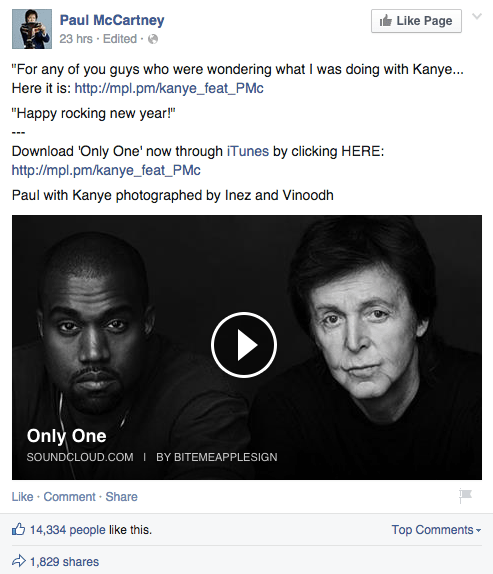
  • Facebook: 14,334 likes and 1,829 shares
Screenshot 2015-01-02 14.10.21
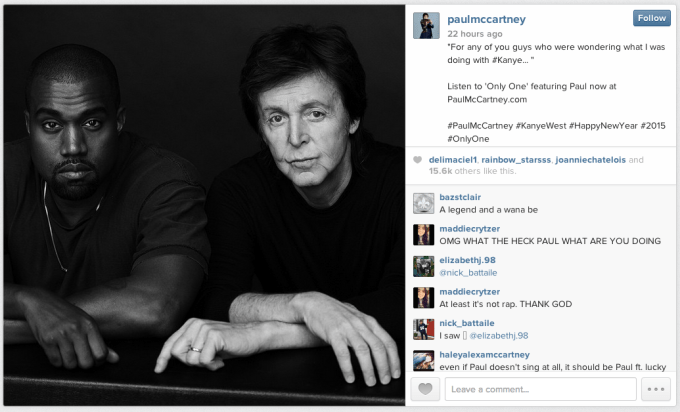
  • Instagram (which did not contain a link to the Soundcloud track): 15,600 likes
Screenshot 2015-01-02 14.11.13
  • Line: 1,074 likes and 31 shares on public post, and push notifications to 10 million-plus fans (see below)
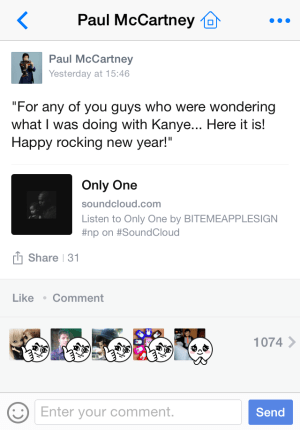
Photo 02-01-2015 13 35 15 (1)


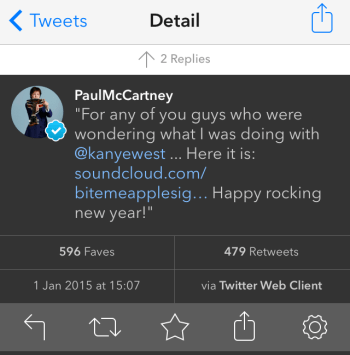
  • Twitter: the @paulmccartney account retweeted Kanye West’s tweet, but only after his team deleted the tweet below promoting the collaboration.

    • Photo 01-01-2015 17 35 02
      It isn’t clear why the tweet was deleted — perhaps it didn’t generate enough interest or McCartney’s team was happier to promote West’s tweet — but the overall engagement numbers are interesting.
      Instagram comes out top in terms of sheer likes — despite a far smaller fan base. While the Instagram post makes mention that the song is available on McCartney’s website there is no URL so just a small fraction of those ‘likers’ may have actually taken action and listened to the song.
      Facebook almost certainly got more attention — with traffic to Soundcloud, iTunes and its own video player — but the problem with posting updates to the social network is that Facebook’s own algorithm dictates just how many of McCartney’s fans will have seen it. There’s no way that it got served to all 6.2 million fans’ timelines unless McCartney’s team bought Facebook ad space.

      The Power Of The Push Notification

      Line does things differently, and McCartney’s post went out to his fans in two ways — via a public post and private chats.
      The figures referred to above are from the post that McCartney’s account made to its Timeline, which — as the name suggests — is a Facebook-like chronological feed of public posts available within a dedicated menu inside the Line app. There, users see all updates from their Line friends and ‘official’ (corporate) accounts — like McCartney’s — which they have chosen to follow.
      Line’s Timeline is governed entirely by each user without an algorithm, they only see items from people they follow and they can also block out accounts they wish to ignore. There is no way a brand can pay to plant their messages there, such as they can do on Facebook, Twitter and (now) Instagram.
      But, most importantly, McCartney’s account also sent private chat messages to each of its 10 million-plus followers on Line. There is no metric to quantify the engagement of that action, but the fact that most of those fans will have gotten a push notification with the message and link to Soundcloud (just like an SMS) gives you an idea that it might well have been hugely effective.
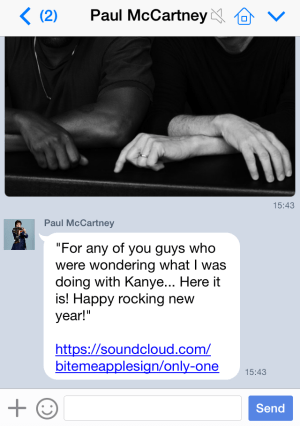
      Photo 02-01-2015 15 17 38
      Indeed, on Line, the Timeline post is just a bonus. Line said in 2013 that one-third of its registered users open their Timeline each month, and gauging the total reach of an official account on Line is impossible.
      Writing for The Next Web back in 2013, I pointed out that chat apps like Line are a genuine threat to Twitter when it comes to advertising cash, and the Japanese company’s Decemberacquisition of Microsoft’s MixRadio service has the potential to supercharge its appeal to artists and musicians worldwide once its proposed music streaming service goes live worldwide.
      But Line isn’t the only chat app that is rivaling social networks. WeChat is becoming the de factor mobile internet in China — it is a must for any brands seeking to reach consumers there — while the same can be said of Kakao Talk in Korea, which is installed on over 90 percent of the country’s smartphones and also offers accounts for brands.
      The appeal of chat apps for brands and advertisers won’t just be an Asian phenomenon in 2015, however.
      Kik, an app that claims to have 80 percent of American’s youth on its service, recently let brands on to its platformSnapchat is planning an Asia-style platform (and it just raised a truck load of cash). Even also-run Tango linked up with Spotify and offers a timeline-feature, while Rakuten-owned Viber introduced a platform for high-profile users in November.

      And Facebook?

      Facebook Messenger is a notable absentee from this list, but perhaps not for long. David Marcus — the former PayPal CEO who heads up Facebook’s messaging business — told Wired that he wants to “reinvent messaging between people and businesses.”
      That will almost certainly mean a system just like Line’s, which allows companies to pay for an account which users can subscribe to for updates. A premium tier on Line grants companies support for two-way conversations, thus turning them into customer sales representatives, and Facebook may adopt that too.
      As for WhatsApp, the chat app Facebook bought for $19 billion, it offers an SMS replacement service rather than a platform and its founders seem to have no plan to change that.
      Asia’s messaging apps have been around longer, and thus most have more mature business models that generate income by connecting brands with consumers, in addition to other non-marketing revenue streams such as games and stickers.
      If 2014 was the year that the West wised up to the potential of messaging apps, then 2015 is the year that they’ll get smart and make money from them.

      Source

      Tuesday, 2 December 2014

      Social media speak to power


      On Kings Highway in Cherry Hill, Unitarian Universalist Church members stand in solidarity with Ferguson residents protesting the grand jury finding in Michael Brown's death. (TOM GRALISH / Staff Photographer)


      'Nothing should be normal or everyday about accepting all this," says Ferguson, Mo., Democratic committeewoman Patricia Bynes. "Social media has helped ensure the images and agony stay fresh in people's minds."

      Ferguson stays fresh. On Sunday, members of the St. Louis Rams did a pregame salute in protest of what they saw as police violence in the fatal Aug. 9 shooting of Michael Brown. That angered the St. Louis Police Association, which called on the National Football League to punish the players. The league declined.

      On Monday, demonstrations around the nation - including at Drexel University and the University of Pennsylvania - organized around the #HandsUpWalkout hashtag. Protesters left schools or workplaces in solidarity with Brown, at the time of day of his shooting, 12:01 p.m. Central time, or 1:01 p.m. Eastern time. Rallies briefly clogged Market Street near the universities. T. Stokes of Philadelphia tweeted: "You know it's real when there's a police helicopter flying above your protest."

      The year 2014 has been the year of social media as social protest. Again and again, people have used Twitter hashtags, Facebook posts, Vine videos, Instagram photos, and messages on WhatsApp, WeChat, and many other media to support and organize rallies, often on behalf of marginalized or mistreated groups. Racial injustice has been the issue in Jacksonville, Fla., (in the Michael Dunn trial) and Ferguson. It was gender-related violence in the Ray Rice controversy and the Isla Vista, Calif., shootings.

      Worldwide, Muslims resurrected the venerable #NotInMyName hashtag to protest Islamist extremism. Demonstrators in Mexico and China use social media to organize and campaign. And all over the world, video game players joined in the #GamerGate controversy.

      So, no question, this is happening. But bigger questions loom.

      Charles Gallagher, chair of the sociology, social work, and criminal justice department at La Salle University, asks: "What kind of legs do social media protests have? Do they change anything? Or is it all just 'slacktivism,' the lazy, next-to-useless click-and-take-credit social in-activism of the 2010s? No large-scale studies as yet can answer that question."

      It's worth noting, though, that the Oxford English Dictionary welcomed slacktivism into its pages this year. It's a thing.

      It's certainly a thing in China and Mexico, with massive, long-term protests honed and organized by social media.
      The "Umbrella Movement" in Hong Kong was fanned by a viral image of a man waving off tear gas with his umbrella during a Sept. 29 protest, largely of students, against mainland control over local elections. "It wouldn't have had that name without social media," says James Carter, professor of history at St. Joseph's University. Within days, a statue of "Umbrella Man" had gone up as a symbol of protest. Carter says that hashtags such as #umhk "helped unify diverse protest groups under this one" - pun intended - "umbrella term." The protest is now into December, with government troops closing public squares and arresting demonstrators.

      In 1989 in Beijing's Tiananmen Square, Carter recalls, "it was the 'cutting-edge' fax machine that got the story to the outside world. That's dwarfed by the number of ways you can do that now. The government knows the world is watching." Authorities tried to throttle Twitter and the "Chinese Facebook," Weibo, but "the protesters are media-savvy, having grown up with social media and smartphones," Carter says. They did ends-around on censorship, turning to one-to-one media such as WhatsApp and WeChat to warn of crackdowns, organize meetings, and get out the story.

      In Spanish, the phrase ya me cansé means "I've had enough" or "I'm tired of this now." In the wake of the horrible Sept. 26 disappearance of 43 students during a demonstration in Iguala, Mexico, allegations arose that the town's mayor was in league with local narco-terrorists. The students have not been found, and national outrage exploded, over both their disappearance and the larger issue of the paralyzing, savage lawlessness in Mexico.
      "These larger issues are systemic in Mexico," says Mark Lashley, professor of communication, who studies social media at La Salle University. "It's fascinating to see its expression on social media there."

      After a long and bitter news conference on Nov. 7, Attorney General Jesús Murillo Karam said, "Ya me cansé" and tried to leave. Those words soon were shoved down his throat via the Twitter hashtag #yamecanse. According to tracking site Topsey, it was used more than 3.6 million times in November. "That phrase," Lashley says, "was tailor-made for a social-media backlash. This is a substantial movement poised to continue, and you're seeing lots of creative uses of the hashtag, both in the demonstrations themselves" - in which protestors sometimes lie down and pretend to sleep or be tired - and in YouTube videos and editorial cartoons, taking government down a notch and allowing social media to work as the people's voice.

      The door of the National Palace on the Zócalo in Mexico City was set ablaze. On Nov. 20, tens of thousands marched down the Paseo de la Reforma in Mexico City and gathered in the Zócalo. Sympathy protests arose in New York; Geneva, Switzerland; and Cologne, Germany.

      So - do such media-driven protests "work"? It can be very hard to tell. In Jacksonville, Michael Dunn, who fired a gun into a van and killed a black man, was sentenced to life without parole on Oct. 17. In Ferguson, Officer Darren Wilson, who shot Michael Brown, was not indicted, but he now says he is leaving the police force. On Monday, the White House published a report and guidelines on "Strengthening Community Policing." On the other hand, the Chinese protest seems as if it's being scuttled. And there have been arrests in Mexico - but not of those being accused.


      So the question remains: When is social-media protest just slacktivism, and when is it something more? And how do we know when it's working?

      US woos Chinese tourists with social media, fried dough fritters and a quiz

      The US travel industry is rolling out the red carpet to attract a most sought-after commodity – the Chinese tourist.
      Some 114m Chinese are expected to travel abroad this year, according to the China National Tourism Administration, making it by far the world’s largest source of outbound tourists and one that is expected to continue growing as the country’s middle class expands.
      Many of these travellers are drawn to the United States, which is good news for US hotels, retailers and tour operators, as Chinese tourists offer a fantastic bang for their bucks, spending $7,200 per visit compared to $4,500 by the average foreign tourist, according to the US Travel Association.
      Still, the US captured just 1.8m – or less than two per cent – of total Chinese foreign travellers. Eyeing China as a relatively untapped source market, the US tourism industry is striving to find creative ways to reach Chinese consumers and tour operators while offering cultural amenities and intangibles to make visitors feel welcome upon arrival in the US.
      Firms such as Marriott and Hilton, the hotel chains, are investing heavily to promote their brands with consumers in China via trade shows and booking agencies such as Ctrip, and have revamped their websites and call centres to make booking and payment easier for Cantonese and Mandarin speakers.
      “In every meeting, we think China,” said Apoorva Gandhi, VP of Multicultural Affairs at Marriott International. “We see a huge opportunity to market to and delight those business and leisure guests.”
      Brand USA, a public-private partnership, has been active in promoting the US as a global tourism destination. Its focus as of late has been facilitating destination marketing efforts and trade shows for US firms looking to court potential Chinese visitors.
      Even state governments are getting in on the act. Last year, California – the preferred Chinese destination in the US – hired the famous actress and model Gao Yuanyuan (seen in an advert for California, left) to help promote the state as a friendly getaway for Chinese tourists.
      Gao helped promote the Visit California site on Sina weibo, a Chinese social media network, which included a quiz that promises winners a “VIP Grand Prize” trip to California.
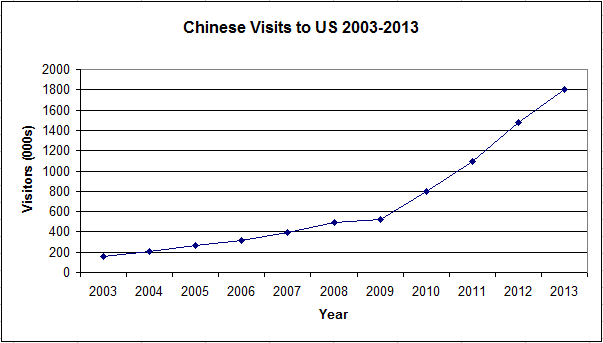
      Overall, Chinese travel to the US has exploded in recent years, with arrivals doubling three times in the past decade. China is now the US’s fifth largest source of long-haul tourist arrivals and projects to be the largest by the end of the decade, a transition that should be hastened by an agreement reached between the two countries last month to expand the validity of tourist visas from one year to 10 years.
      But getting Chinese visitors to the US is just one side of the equation. Ensuring they feel welcome and enjoy themselves is another challenge.
      Seemingly intangible services that help to bridge the cultural barrier, such as offering better language services and traditional Chinese foods and drinks, are now seen as crucial to making Chinese visitors feel at home and keen to return.
      Elliott Ferguson, head of Destination DC – which promotes tourism in the nation’s capital, says he’s focusing on hiring more tour guides fluent in Mandarin and Cantonese and has Chinese nationals on staff to help build relationships with Chinese tour operators and better welcome host visitors.
      Hilton Hotels offers a service at 27 of its US hotels that specifically caters to Chinese travellers. Known as Hilton Huanying – a Chinese word for “welcome” – these properties provide amenities such as Chinese teas and slippers, Chinese television programming and traditional Chinese breakfasts featuring fried dough fritters, dim sum, congee and fried noodles.
      The approach has yielded positive results.
      “According to Hilton guest satisfaction surveys, Chinese travellers who stay at our Hilton Huanying properties respond with higher scores in terms of overall experience, overall service, property loyalty and overall accommodations,” said Jon Scofield, a senior director at Hilton Worldwide.
      In addition to the welcoming gestures, offering new and unique upmarket experiences that venture beyond simple sightseeing is also seen as crucial to keeping the tap of Chinese visitors flowing. Activities such as medical tourism, university tours, high-end shopping, golf and wine-tasting are likely continue to growing in popularity among Chinese tourists as visitation increases.

      Friday, 28 November 2014

      Amazon answers 'Double 11' with Black Friday

      Screenshot shows Amazon's "Black Friday" shopping carnival will kick off for the first time in China from 9 am on Friday. [Photo/amazon.cn]
      Amazon plans to bring this year's "Black Friday" shopping spree to China, a move seen as escalating the competition with Alibaba in the world's biggest e-commerce market.
      The western shopping carnival will kick off for the first time in China from 9 am on Friday, said Amazon on its website, when online shoppers can search for best deals the first day after Thanksgiving and shop for Christmas.
      "Black Friday" versus "Double 11"
      There are about 800,000 items on Amazon China's dedicated website for overseas shopping, with categories ranging from garment, shoes, makeup to health care and sports. Delivery takes as little as three days to two weeks on average, according to the website.
      Amazon China will offer up to 70 percent off on about 35,000 products from 9 am to 4 pm on Friday, 6,000 of which will be exclusive, reported Chinese financial media Caixin quoting the company's information. The campaign in China will last throughout Saturday, which will be Friday in the US, when some of the products will be sold at half price.
      Caixin added that with a delivery system covering 3,000 cities in China, Amazon aims at creating "a festival for overseas online shopping" and extending its international strategy.
      Amazon launched the Chinese site on Nov 11, a day also known as "Double 11" or "Single's Day" in China and celebrated by young people shopping online.
      Alibaba created the Chinese version of the shopping festival in 2009 and has made it a tradition since then. This year was the first time that the e-commerce behemoth launched the campaign on both its domestic and overseas platforms. Online sales on Alibaba's Tmall.com, Taobao.com and its overseas outlets, such as AliExpress, topped 57.1 billion yuan ($9.34 billion) on Nov 11.
      Jockey for cross-border e-commerce
      While Amazon is working on its Chinese site to attract Chinese shoppers into the "Black Friday" campaign, Alibaba's payment arm Alipay is teaming up with a group of high-end retailers in the US preparing for the same promotion.
      Merchants participating in the first Black Friday promotion include Saks Fifth Avenue, Neiman Marcus, Bloomingdale's, Macy's, iHerb, Gilt, Ashford, Ann Taylor, American Apparel and Aeropostale.
      "Alipay is delighted to partner with Borderfree and Shoprunner to help leading US retailers introduce Black Friday to China and reach out to eager new customers through well-managed localized promotions, direct marketing and social media campaigns," said Rebecca Lui, director of marketing and public relations for Alipay US.
      According to Bloomberg, Alibaba is open to working with eBay's Paypal and Apple's payment system to expand payment options and keeps exploring overseas market.
      Alipay also announced its plan to set up a subsidiary company in Sydney and support cross-border e-commerce between China and Australia on Tuesday.