Showing posts with label social marketing. Show all posts

Monday, 14 December 2015

How You Can Use Emotion to Increase Conversion Rates (5 Concrete Steps)

guide to increase conversion rates in eCommerce

Think back to your last purchase. Why did you make it? We are drawn to complete a purchase when either the product, its price, or another element in the shopping experience successfully triggers an emotion suitable for that purchase.
We don’t make purchases just because we “like” something. The emotion is much stronger than simply liking something. In a study regarding the effect of emotion in eCommerce purchases, researches found that websites with a stronger emotional impact produced a greater intent to buy! Today we’ll get into how you can do the same for your eCommerce business.

Proven Example

The team at conversioner was able to increase the number of paying users for one of Asia’s biggest online dating sites by 340% with the use of emotional targeting. How did they achieve such optimal results?
The dating site got a new landing page that triggered a more relevant emotion: simplicity. In that specific case, a design that demonstrated the wide variety of people that could be met through the service made visitors feel wanted (see below).

using emotion to increase conversion ratesImage via Conversioner

As you’ll see in this post, the smiling faces (more than one type of person), combined with a very short catch-phrase is all that’s needed to increase conversion rates. That’s a dating site, but the same tactics work for eCommerce conversion rates too.

How to Use Emotion to Increase Conversion Rates

Emotion: a conscious mental reaction (as anger or fear) subjectively experienced as strong feeling usually directed toward a specific object and typically accompanied by physiological and behavioral changes in the body (Merriam-Webster Dictionary).

Step 1: Who’s the Customer? Define the Buyer Persona

We won’t get into the technical details of finding your customer persona in this post. Just as multitasking is not a great idea, covering two very different, although connected topics, in the same post is also not a great idea.
However, to make sure this post helps you use emotion to captivate your shoppers, we’ve got to cover the basics. The buyer persona should be comprised of four basics factors:
  • Demographics – age, gender, location, employment, education, etc.
  • Interests – what your target customer is interested in
  • Purchasing motivation – why your target customer wants to buy from you and what they hope to accomplish
  • Purchasing deterrents – things that will hold your customer back from purchasing from you
The goal is to discover exactly what type of person your ideal customer is. The more you know about who you are trying to sell to, the more efficient your business will be, and the easier it’ll be for your to trigger the right emotion. Who is your ideal customer?

Step 2: Picking an Emotion to Trigger

What do you want to trigger? Is it a sense of trust? Maybe you want to trigger necessity? For each business, the answer can and will vary. One common trait found across the board to be true for businesses: positive emotion toward a brand has a deeper influence on customer loyalty than other triggerable emotions that are based on the traits of a brand.

How Air BnB uses emotion to increase its conversion rate

Airbnb has more than one buyer persona, however there is one similarity across the board: the need for a cozy, good night’s sleep just like home, triggering trust, warmth, and belonging.
Emotions that work for every site:
  • positivity
  • belonging
  • trust
  • jealousy
  • fear
  • value
  • instant gratification
What works for your site might be fear, while for someone else trust is the key emotion. You need to use the buyer persona to understand what makes the customer hit the gas full strength.
For Titika Active, it looks like jealousy or belonging (think of 20 something females) could be the emotion that they’re trying to trigger with the help of the lady on the right and the strong typography. Why jealousy? It’s on the female in the promotion, but not on the the female customer. If she’s jealous, and feels like she is part of the brand, then a purchase is inevitable.


The Coupon Pop uses emotion to trigger a purchase

Step 3: Using the Right Text (Copy)

Were all words created equally? Maybe they were created equally, but not all words have the same power or influence – even when they may have nearly identical definitions.
When it comes to the copy that you are using – whether to describe a product or on a new site-wide promotion – less is more. Research from the Nielsen Norman Group shows that visitors read less than 28% of text on the page! The lesson is to keep the text to a minimum, make it easy to skim for speed readers, and use the best words that will be read.

The Right Adjectives

You know that not all words have the same effect and that too many words aren’t being read. The next step is to active the right words that will be read. Instead of using common adjectives that leave your customers debating your product, use adjectives that have a concrete meaning.
For example, perfect vs. great. Great can mean many thousands of different things, whereas perfect has a simplified and stronger meaning: it’s the right fit, and there is no better one.
Remove these adjectives from your vocabulary:
  • great
  • awesome
  • amazing
  • cool
  • terrific
  • unforgettable

Using Emotionally charged adjectives to increase conversion ratestrust and instant gratification

What Bed Bath & Beyond Gets Right: it’s clear that I am getting a product that can get the job done better than the rest. There’s no shortage of trust, value, or instant gratification.

Using Adjectives to trigger emotionpower and value

What Atlas Wearables Gets Right: it’s clear that this product will enable me to take my fitness to the next level. A sense of power and value are the first emotions that hit me.

This much is clear: using adjectives that provide a clear picture of what it will be like to use the product are the ones that lead to a noticeable improvement in your conversion rates.
Add these words to your vocabulary:
  • perfect
  • essential
  • empower
  • smooth
  • clear
  • versatile

Step 4: Images and Design

Your design needs to do the same thing as your text: bring to life an emotion that will make the customer complete the purchase. If the goal of your text is positivity, then the design should do the same. If your text is all about value, then the design should be that too.
According to web designer Paul Jarvis, in order to trigger emotion, your design needs to get four things right: visually appealing, enjoyable, memorable, and personal. You need to use those four cornerstones together to jolt the emotion to life.
The following image from Adidas is spot on. Even if the words “I’m not done” were not in the image, we would all still be able to understand that the brand stands for work ethic and competition.
Does this meet all of Jarvis’ basic points? You be the judge.
The sweat, action, and frazzled hair all resonate for their potential buyers that take pride in their work ethic. As a result, the customer is motivated and maybe a little jealous of the women in the picture.
The image is visually appealing, enjoyable (for their buyer persona), memorable (even more with the added text), and personal. The next step is completing the purchase.


Example of Adidas using emotional imagejealousy and power

Over the last few years Dove has rebranded itself to be the brand for anyone and everyone – especially within the different types of females.
The first thing you see on their site is the following image. This design is as basic as it gets, yet it is still able to generate emotion within the customer. In this specific case, Dove is able to elicit a feeling of belonging for every customer that lands on their page.

DoveVisually appealing, enjoyable, memorable, and personal: belonging and trust

Below is a Coupon Pop being used on the eCommerce site PYTHair. The design hits the nail on the head. Without paying any attention to the tax, the team uses the color blue and an image of a young lady – after using their product – to create a sense of both trust, happiness, and jealousy.

eCommerce brand uses emotion to increase conversion rate

Step 5: Emphasize Benefits and Not Features

Notice that in the above Coupon Pop the brand did not mention their products or add an image of one of their products. They sell an experience that makes their customers happy; beautiful hair.
Now go ahead and visit the most successful eCommerce website you know of – whether it’s a giant brand or a small business. You will notice the same thing. The site, the pictures, and copywriting is all presented in a way that reflects the experience of using the product.
Why? Images and text that reflect the experience of using the product is much more emotionally engaging.
Notice the below image from Asics. For me it stands out because it makes absolutely no mention of any feature. All it does is tell me what I want to know – run more!
image: http://cdn2.business2community.com/wp-content/uploads/2015/12/Asics-Gel_Kayano.jpg.jpg
promote results and not features“More Miles” is the experience

Here JCPenney does not mention one bit of information about the technology or about some flashy feature. They sell people the experience of using the products.

Cuisinart

Both Asics and JCPenney pass on mentioning features because although they may be important, generating a strong sense of emotion is much more difficult with a feature, whereas with an experience the customer gets to know the result. Results are what matter to your business, and they are what matter to your customers. Great results means happy people. Happy people spend.

Pro Tip: Typography

The font you use may matter more than you think. Although you might be limited to the type of fonts you can use in your themes, with the Coupon Pop you can use any Google font. This graphic breaks down just a few types of fonts and their psychological meanings in regards to the emotion they encourage.

Fonts represent an emotion

Putting it All Together

image: http://cdn.business2community.com/wp-content/uploads/2015/12/jiffylube.png.png
An exemplary homepage that utilizes emotion

Jiffy Lube is not an exciting business, at least not as much as say Nike, Jaguar, Uber, and others. In their own words, “a chain of over 2,000 businesses in North America offering oil changes and other automotive services”.
With this homepage design however, they have become exciting to their visitors. How much text? Only six words. Not only is the quantity perfect, but so is the quality of the words used, such as “worry behind” and then “clear driving ahead”.
The image completes the text, by using what appears to be a happy couple, using an old-school car. In addition, whether you noticed or not, the mirror reflects the man’s smile, while the passenger waives her hands in the air. These actions serve as proof to the text.

Emotion Clouds the Mind

Emotion is what take the customer from step A (wanting the product) to step B (buying the product). The goal for your eCommerce business is to improve your conversion rates. At the end of the day, that goal is one factor (high vs. low conversion rates) that plays a major role in whether you turn into a relevant, growing brand or not. The means to achieving this goal is by triggering the right emotion.
Once you are able to trigger the right emotion, all the rest of the pieces fall into place.

Your Homework

What is the buyer persona of your site → What emotions will make completing the purchase an urgent process? → How can you bring that emotion to life in as few words as possible? → How will you describe the experience your product offers? → How will you bring the emotion to life with images and overall design (including fonts)? → Constantly run A/B testing until you have found the winning emotion.
Good luck! If you’ve got any questions or comments, we’d love for you to say something in the comment section below.

Wednesday, 25 November 2015

Building brand advocates in a connected world

my-gen-1


To create brand advocates and ultimately increase conversion efficiency, connect and engage with audiences by leveraging social media platforms such as Facebook.

I saw the graphic below in a Facebook post the other day - take a look at the image below and ask yourself how do you relate to this?
my-generation
I’m almost 60 and I certainly identify with the upper photo. But then it hit me - I actually live like the lower photo.
As I thought more, I realized both photos are the same:
  1. Both are shared experiences: in both, the experience is connecting people.
  2. Both are mental experiences: no one is actually looking at anyone in either photo.
  3. Both are reflective of current technology: the bass is electric.
What is really more significant is the comment written across the combined photos; it implies a values judgement based on generational differences in what it means to be connected - this matters from a business perspective.
To be sure, people of various demographic groupings do in fact use social technology in different ways, but equally, the use of social technology cuts across traditional demographics as well. It’s less important how people connect than that they do connect. Given the ubiquitous nature of social technology, people - all people - do connect.
Connections between people are built around shared experiences; people don’t just connect to connect, they connect to share. Where interaction used to require physical proximity (like playing music in a park) the equivalent interaction now only requires network connectivity, enabling customer experiences to be shared widely and quickly. This has purchase funnel implication at the mid-funnel consideration phase in ways that trump advertising – or the top of the funnel - that undermines point-of-sale and similar bottom-of-funnel tactics.
From a strategic marketing perspective, it’s important to understand that shared experiences, particularly experiences shared across digital networks by contemporary, tech-savvy consumers are as real as any shared physical experience. But too often marketers still approach the task of conversion from the perspective of a prior generation; that interruptive advertising (think “TV”) remains effective among a generation of cord-cutters and increasingly cord-nevers.
Marketing based on shared experience - the new norm for information exchange - is much more accurately modeled by the loyalty loop, rather than the purchase funnel. The loyalty loop, shown in the figure below, is a construct that considers the role of advocates and influencers connecting via social media as critical to the conversion process.
my-generation-2
The purchase funnel is a linear concept based on an outdated understanding of consumers:
  • Drive awareness.
  • Capture share-of-mind.
  • Convert.
Want more conversions? Drive more awareness. Sure, you could also increase conversion efficiency, but in a medium that protects and promotes exaggerated claims - legally, it’s referred to as "puffery" - why go to the trouble of actually improving your product? Just claim that it’s better. Right?
Wrong. In the more modern view, the loyalty loop makes clear that advocacy – which are customers willing to actively recommend your product - are critical business success. Advocacy is built on the customer experience, not advertising. Consumers have redefined their media streams, limited their interruption via ad blocking, and now routinely share experiences with each other. Your active development of advocates by providing a superior customer experience is therefore key.
Assuming you have the loyalty loop working - think of this as your advocacy engine - the marketing question is, “How do you attract prospects into the loop?” Again, the answer is social technology.

Create a space where customers and potential prospects can ask questions

Have a place where consumers can get answers about your brand or product concerning what works, what doesn’t, how to fix things, how to upgrade, and so forth. By doing so, you can gain a significant SEO advantage and thereby attract new prospects. When someone searches for a specific brand, product, or service, very often, the top-ranked results are mobile-friendly discussion forums, blogs, and similar support sites - you can build on that.
birchbox-convo

Find and join other conversations already happening

With literally billions of people using social networks, there are nearly always conversations happening that are relevant to your business. Using your social engagement tools, you can find these conversations. You can review the content, authors, and other metadata associated with these conversations to spot potential sales opportunities as well as issues that prevent advocacy. Additionally, you can spot potential advocates and them share their experiences. All of this can be used to build participation in your developing loyalty loop.

In conclusion

The end result is worth the effort. Create the kinds of experiences that people enjoy sharing and that they will naturally talk about between themselves, and you’ll gain an advantage in a connected, networked marketplace. Whether it’s guitars in a park or smartphones in a backseat, the result in the same - when advocates talk about you and when your own customers share their experiences with others, you win.

Friday, 20 November 2015

Why Psychology is the Future of Social Marketing

marketing psychology quote


What do marketing and science have in common?
How can we combine the two to better build our brand reputations?
The answer to these questions are: they have the human brain in common. And when we combine the two together, we have a recipe for success.
You’re about to go where no marketer has gone before.
Are you ready?
Our brains have learned how to react to spamminess. When it’s exposed to too much commercialism and “selly sell selling,” it shuts down. The brain stops all communication with that message trying to get your attention.
So how do you take advantage of psychology in your marketing? You have to be a smart marketer, not a boring one.

The boring marketer

The boring marketer doesn’t understand the dire need to capitalize on their marketing in ways that are new, fresh, and different to their target audience.
Instead, they come back again with the same marketing strategies from a decade ago. When it doesn’t work, they just push the message harder and try to wear down the few remaining people that are listening to them.

The smart marketer

You’re a smart person. I have no doubt in my mind that you are. You’ve chosen to participate in one of the most stressful jobs that you can have, are constantly changing and adapting, measuring and comparing analytics, etc. And you’re doing this all because you want more results, better results!
That’s what smart marketers do, right?
In fact, the smartest marketer will understand that there is a psychological trigger involved in creating that sale or adding that subscriber to their list and they take the necessary actions to get their audience to do so.

The smart marketer realizes that what may have worked yesterday, may not work today. People are always changing. Their likes and dislikes evolve, and as a great marketer, you understand that you have to roll with the changes.
So why not involve more science and psychology in your marketing? Learn more about the brain and human behavior. Understanding the actual triggers that get a brain to make a decision will make it all the more easier to get customers to convert.
I want to explain some action triggers that smart marketers are successfully success. This is where you can start using psychological marketing to your advantage.

Repetitive marketing

Have you ever watched a television commercial that had a phone number on the screen?

Sure you have.
But what you may not have realized is that when the announcer speaks over the commercial, they usually give you the number not once, but three times.
That’s significant. It’s not twice, it’s not four times. And it’s three for a reason.
The repetition from the commercial is now ingrained in your memory. It’s like having a song so stuck in your head that you start singing it without realizing.
Use repetition with your marketing messages to help your audience remember them.

How to do it

Repetitive marketing can work really well on social media.
The main thing to remember is to stay consistent with everything. Your message, your content, your brand, and your engagement. You’re indirectly “selling” every time you help someone, or write a great article solving someone’s problem.
Something else to concentrate on is sticking to whatever it is you’re trying to accomplish. Set a blogging schedule and stick to it. Visit your most successful social channels every day, and stick to that strategy.
Do that over and again, and you’ll start to see the psychological effects of repetition. Your followers will see you as someone that’s helpful, with knowledge and stability. Because when your ideas are consistently there, people become attached to that idea.

The comprehension factor

There are all types of psychological ways to improve the clarity of your message, so your audience better understands it.
You can do so either logically or emotionally.
Under the umbrella of these two comprehension factors lies a whole community of triggers and responses that are lying around in the human brain.
Let me explain the logical side first. These are the ways you can reach people using this frame of mind.

Left-brained marketing

Let’s brush up. The left side of the brain is known for controlling the right side of the body, and the more academic sides of the brain.
Left-brained marketing describes products and services from a practical standpoint. It talks about what you get, why you need it, and why no one else does it like they do.
In the article above, they explain how facts, testimonials, and other truths and hard evidence that make us realize that this is the right product for us to purchase.
Appeal to this side of the brain by stating facts to the reader. If they do this one thing, this other thing will happen. Cut and dry, no sugar coating. That’s the way it is.
It’s a pretty straightforward approach that most marketers use today. And while that used to work a lot back in the day, today’s consumer’s attention span makes that a lot harder.
Can the logical approach be used alone to grab sales? Sure.
When you can make your case in the few seconds the audience is paying attention, it will work.
However, it works better when coupled with creating emotion. That’s going to put you on the road to faster conversions and more customers.

How to do it

Tell it like it is. Show your audience why they need your product, how they could use it, and what it can do for them.

The right-brained marketer

The right side of your brain is where creativity is stored. Right-brained marketing doesn’t necessarily sell the product, but the dream.
Your product is only a bridge to take the customer where they want to go.
When appealing to this, focus on building a robust and personality-rich social marketing plan that spreads brand awareness and gets people talking about the product. They use a massive amount of visuals. They’re focused less on the product, and more on the person using the it. That drives a connection.

How to do it

Visuals are your friend when it comes to getting people to connect with your product or service.
If you were trying to sell a timeshare in Florida, you wouldn’t show an image of the condo, but rather of a family having fun and making memories on the beach, with the condo in the background.
You are painting an image in the reader’s head of the result you want them to be thinking about after they do whatever it is you’re wanting them to do.
It’s connecting them on an emotional level.

Final thoughts

You need to use all of the tools that you have at your disposal.
A carpenter wouldn’t go to work with just a hammer and nail, without a tape measure, pencil, and saw. Even though he’s known for the hammer and nail, these other tools help him get the whole job done.
If you aren’t using science and psychology in your marketing today, then you aren’t using all of the tools at your disposal.
When creating your campaigns, ask yourself these questions:
  • How does this factually make the case for your product?
  • Does this move me on any level, does it make me feel something?
Having conversations will level the playing field and help you to understand what you need to say and do to help your customers. From there, it’s a fine-tuning process.
This is all one small step for science, one giant leap for the marketing industry.

Saturday, 14 November 2015

4 E.A.S.Y opportunities you must master before 2016

easy-st-flickr-569593575-4c368e5f9d-z

Creating consumer-centric experiences and solutions can be "easy" and will help separate the winners from the losers in 2016.

As technology continues to innovate at a pace more rapid than we can implement or wrap our heads around, we continue to be challenged with assessing new changes, seeing around corners, and latching onto a few key initiatives we believe will drive success. One of these recent phenomena occurs at the intersection of experience, design, and technology. Firmly grounded in what Forrester has deemed "the age of the customer," the ability to create consumer-centric experiences while exploring innovative solutions for creating strong bonds, has unlocked unlimited potential that truly drives the bottom line.
While it may seem challenging or confusing to some, harnessing these opportunities is quite E.A.S.Y in theory. Winning at this level is dependent on your ability to master these four mandates.

1. Experience

Experience is king these days. Ask yourself this question: Do your customers find your brand experience engaging, exciting, and enticing?

If you are not obsessing over every single brand experience, you are not just missing out - you are losing. This is not limited to your product either; your app might be great and your website might be fantastic, but how does the customer view your brand?

Great brands like Coca-Cola are finding incredible ways to merge the innovation with experience in subtle but powerful ways, partnering with companies like DanceOn for the recent season of Dance Showdown.


2. Addictive ideas

Do you offer addictive ideas that move people to act?

Channel Uber here. Initially, no one needed Uber - it was only after trying it did people realize the app's true potential. Now, many love it so much, that they will even Uber kittens to cuddle with for 15 minute increments.
uber-kitten
Your products or offerings need to have an addictive quality to it. Find this quality and capitalize on it in a fun and innovative way.


While Uber continues to display success here, Chipotle has also done this brilliantly with its Cultivating Thought author series
This campaign has not only added to the Chipotle's addictive quality, but it also brings a taste of culture to hungry consumers too.

3. Solve a simple problem; simply

We’ve all become prey to the Alice in Wonderland "rabbit hole" conundrum.
alice-rabbit-flickr-3355824586-305ea883d1-o
After setting out to create something, it becomes a myriad of mazes, twists, and turns so complex that sometimes launches completely fail or campaigns never make it live.
"Keep it simple" is a strong mandate we should all live by. Ringly's smart jewelry keeps it simple and fulfills an important need by "filtering the most important messages down to your core group" via one product - a ring. Its success stems from its sensational, yet simple model.

ringly

If your efforts are not laser-focused at solving one core problem, you have some work to do.

4. Yap, yammer, and yell

This mandate is critical. No matter how amazing your brand experience is, how addictive your products are, or how masterfully you can solve problems with ease, if you do not have the infrastructure in place to make it sharable in a powerful and meaningful way, your success will be limited.
Ad blocking, Facebook Instant Ads, and a myriad of other challenges have made it critical to partner with an expert in this area. For example, companies like Spotify, GE, The Dodo, and others have chosen to do this with RebelMouse, a publishing platform that leverages SEO and social discovery to distribute content.

To sum up

No matter what size, shape, or type of company you are involved in, make 2016 the year you master these four E.A.S.Y steps and innovate in a compelling way. Your customers will thank you.

Source

Friday, 13 November 2015

Separating the 'what' from the 'how' in digital marketing

Marketers that align messages with the right communication platforms and take a multichannel approach to campaign strategy can ensure that their content will reach targeted audiences.
All too often, when I meet with marketers, I find out they are planning a new campaign and making a huge assumption that they are going to solely focus on email to get their message out. If I have done my job in this column, then you will step back and no longer make that assumption.

There are lots of ways to get your message out there. Taking time to assess the right channel for each message could pay off handsomely with improved engagement and results.
Remember when you were in elementary school and while learning new vocabulary you had to learn to say the words, write them down, use them in a sentence, and even work them into a story?
vocab-prep-flickr-4838276667-3b0e17a02f-b
Although we really didn’t know it at the time, these multichannel approaches really helped us learn the material - not just for the weekly spelling test, but (hopefully) for a lifetime.
create-content-4709700483-c6c7f2770e-z
Well, the same applies with campaign offers and content: the more methods and approaches that are taken with marketing tactics, the more memorable campaigns will be. 
If you’re launching a new campaign, a multichannel approach that integrates snail mail, SMS messages, infographic-based ads, calls from reps, social posts, a Web-based diagnostic tool, a call center (outbound or inbound) - and yes - also a few emails, will reinforce your offers and appeal to every learning style.

What are your overall campaign objectives, and who is your target audience?

The first step in any campaign plan should be to determine your overall objectives and target audience specifications.
  • Which personas make up your core audience?
  • What roles make up the other segments that you’d like to influence?
  • What is your audience's current state of mind?
  • Do they already know about your company, product, or solution - or are you starting the awareness process from scratch?
  • What is your time frame for executing the campaign?
  • How will you measure activity, influence, and results?
An engagement scoring model can help you automatically assign points to track activity and influence, giving you a real-time view of your progress.

What content will you use?

Build a content matrix to name all the content you’ll need for each persona and each stage in the customer journey. Note what photograph, design, or other assets you will need, so you can give your creative team a head start on their own strategy and production work.
content-matrix-flickr-4534857938-96d8afe2c7-z-1
So often we leave those elements to the last minute, causing our digital agency or in-house creative teams huge amounts of stress, and I have rarely seen stressful creative teams perform at their best.

Will you use in-house or external writing talent?

Now is the time to tee them up for your project. Know that if you give your creative team free reign to choose the channel that might work best, they might have some great ideas about the optimal channel on which to deploy what they have created.
Make sure you are collecting other channel information. You might realize that SMS would be a fantastic way to reach your audience, but if you don’t have many mobile numbers it will be hard to leverage that channel - the same goes for physical mailing addresses.
A great way to make progress is to enlist your call center representatives to help you complete your audience’s profiles. If you have your call center integrated with your digital marketing platform, then any cell phone numbers and snail mail addresses should port over to your digital platform.

Conclusion

Only when you have your campaign targets and objectives, key personas, content framework, and a creative strategy in place, should you begin to think about which channel is best for each tactic. Of course a few will be email, but by adding in other approaches you’ll create a richer experience for your clients and target audience.

Wednesday, 14 October 2015

Digital Content Consumption: How Well Do You Know Your Audience?


“How well do you know your audience?” This is a question that many of us writers and content creators take to heart since the very early stages of our professional training. Unfortunately, as content marketing gains popularity, we find ourselves caught in a race that has nothing to do with engaging the reader but to churn out x number of content a week (if you’re lucky). For some writers on news and community websites, you’re faced with the challenge of writing as many as ten articles a day even.
This type of volume-based writing is more for the SEO-writer but not for the other types of writer. Apparently there are many writing styles that got neglected in the online world such as descriptive writing, narrative writing, persuasive writing, and technical writing.
Let’s take a peek into consumer psychology. Quite obviously, if you’re writing for a middle schooler, you’d want to use a different tone of voice and choice of vocabulary as oppose to writing for someone in their thirties. The concept is essentially the same when writing for consumers of a brand. The only difference is that when you’re working for big brands, the scale at which you would want to understand your audience becomes enormously important.
Millennials, Generation X and Baby Boomers
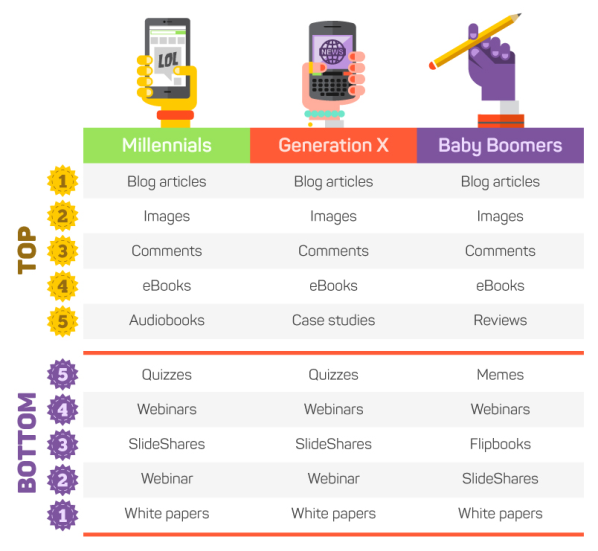
Let’s begin by splitting your audience by age group: the Millennials, Generation X and Baby Boomers. A recent research by BuzzStream and Fractl identified that the top 4 content types for all three segments are the same. The takeaway? You definitely don’t want to skip blogging and using images whenever there’s the opportunity.

content consumption
source: socialmediatoday.com
You Won’t Finish This Article

The headline of this section says it all. Online readers just do not invest time to read every single word of an article. Does that mean you should be stuffing everything that is important in the first two paragraphs? Probably not. That would only jeopardize your article quality and flow.
Instead, make good use of headlines and sub-headings. Regardless of the medium, whether it’s a newspaper print, pocket book or online article, headlines, titles and chapter headings will always capture the reader’s attention first.
For online writing, good use of sub-headings would mean audiences have more freedom to jump between parts of the article. It also helps to make the article more digestible.
Finally, if the consensus is that many online readers rarely complete reading a whole article, most likely they would jump to the very ending for the conclusion. This makes the last paragraph very important. Whenever possible, make it a habit to sum up the entire article into a concise last paragraph.
The Multi-Tasker
There is no denying that a large portion of online content consumption now happens on mobile devices and portables. (Yes, I know that you know that mobile is important and you already have a plan that involves responsive websites, faster rendering and so on.)
Besides the technicalities, for the writer, it’s worth to note that the audience behavior when consuming content on mobile and on desktop is significantly different. Hence, there is more to content optimization for mobile readability than the standard layout and appearance. For the writer, you’re in fact optimizing your content style and writing to meet the multi-tasker-type audience. While desktop readers may multitask by switching between two tabs, or have some music running in the background, the mobile reader is commuting on public transport, having lunch, running on the treadmill or even while walking in the park.
In China, there is even a phone lane for those whose attention is split between consuming content on their mobile phones or chatting, while also commuting.
The takeaway? For long articles, the audience may quickly lose their spot when they are multi-tasking. Use lots of images and sub-headlines to act as breaks and bookmarks. The use of slimmer paragraphs would also make long articles more digestible.
Headline Skimming and Image Scanning
Online reading behavior is simply different from offline reading. Reading print encourages you to really focus on what you’re reading while digital reading tends to be more of a surface-level reading. The rise of social media, that basically works around images and text snippets further influence this habit to skim headlines, scan through a few keywords and scroll over images.
The takeaway? Similar to the previous section, you’ll want to make sure your headline stands out and do make use of sub-headings. Since most headlines will appear in bold, a larger font-size or different color, when your audience skims through the article, these headlines will stand out and encourage the reader to continue skimming through. Is skimming bad? As a reading behavior, most probably yes. For those who are tight on time (which is quickly becoming the norms for many people), it’s a great skill to have. For brands, making good use of headlines and images may just be the deciding factor whether your content marketing sees fruition.
So How Well Do You Know Your Audience?
In summary, research pinpoints that regardless of age group; most online content consumers prefer blog articles and images. The increase use of mobile devices for internet browsing nevertheless puts forth new challenges. Long articles can be made to flow better and easier to digest by the use of sub-headings and slimmer paragraphs.
While this article focuses on the behavior of consumers when it comes to reading online content, other factors that may determine the success of your content development strategy is of course, to also have a clear understanding of your brand’s products and services.

Source

Monday, 5 October 2015

4 Steps to Creating an Effective Social Media Strategy

The social media revolution, which has been sweeping the world since the middle of the last decade has slowly been transforming the way businesses and customers interact. Combined, the number of users of the Big Six social networks (Facebook, Twitter, LinkedIn, Instagram, Google+, and Pinterest) exceeds 2.4 billion people. The largest of which, Facebook, would be the second most populous country on the planet, after China.


Reconsidering Assumptions
As a strategy, engaging and winning customers on social networks is often incorrectly described as ‘free’ marketing. This isn’t really the case, not after considering the fact that implementing a social media strategy requires time, content and staff to take the lead online.
Another incorrect assumption is that social media marketing often generates the idea that an ROI should be near instantaneous and easy to measure. Tweets do not, by themselves, generate sales. Likes do not mean that a customer is about to make a purchase. Measuring a positive impact of your activities will take time so anticipate a cumulative effect from what you do, not instant.

Almost all social networks now offer advertising and paid-for targeting as an option. The different ways you can target customers across the various social networks is outlined below.


Pay-per click (PPC) advertising is a simple way to get started on social networks since ROI can be measured directly from a marketing spend. The challenge when it comes to creating your social media presence comes down to four factors: strategy, voice, implementation and measuring. Here is how you can tackle each of these challenges:
1. Define Your Social Media Strategy
Launching a social media campaign, whether organic (interacting with people online, creating and sharing interesting content) or through advertising, without a clear strategy is a common mistake that can lead to poor ROI.
Before you start on social, decide what your objectives are. Ask yourself what are you offering to your audience and how does it benefit them? How does social tie into your overall campaign goals? Which network(s) are right for you? Who is your audience and how you are going to target them? And most importantly, how are you going to dedicate the right resources / team members who can implement a suitable strategy?
2. Identify Your Unique Voice
Online, there is more value in less. Every word counts. Your tone and the crucial elements of your brand’s voice, need to be conveyed in a short, friendly, engaging and consistent manner. Each Tweet, status update and image is a reflection of your brand values, which is why special attention has to be paid to how your voice is conveyed online.
3. Make an Investment
Determining your readiness for social media is based on a simple question: how much can I invest in this strategy? Who will implement this? Do we have the skills? Like with anything, you get what you pay for. Creating engaging content is an investment, as is tasking staff or external agencies to manage a social media strategy strategy. It will pay off. It takes time, as the results are cumulative, which means it is worth expecting to play the waiting game when it comes to launching a social media strategy.

4. Measure Your Efforts

Taking the above into consideration means knowing what to measure and how to modify tactics as you move forward. The individual impact of certain metrics, like the number of followers, likes, re-tweets, carry different weights depending on who you speak to. Some so-called ‘experts’ will give these metrics great importance, whereas some will focus on the quality of your followers and engagements over quantity.
Ultimately, it depends on your goals and objectives: what do you want to accomplish and when do you want to achieve that? Create suitable metrics which matter to your business around the answers to these questions.

Source